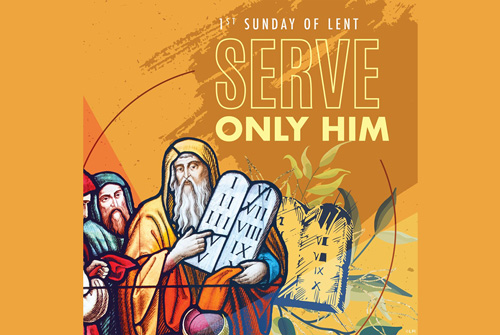
First Sunday of Lent
Reading 1: Gn 2:7-9; 3:1-7
Responsorial Psalm: Ps 51:3-4, 5-6, 12-13, 17
Reading 2: Rom 5:12-19
Gospel: Mt 4:1-11
As we are now in the Extraordinary Season of Lent, the overall message of our readings for the next few weeks will be the discernment of our evil tendencies and our desire, through the grace of God, to confess and modify those tendencies. We are to discern the difference between the trials and tribulations of daily life, which strengthen us when we deal with them appropriately, and the temptations we face which only lead to sin. Temptation does serve a useful purpose in our lives because it reveals our weaknesses and causes us to recognize them and to pray for the strength of the Holy Spirit to overcome those weaknesses.
Our first reading this week is from chapter 2 of the Book of Genesis and there are those who would like to believe that what we read here is an historical account of the creation of the world. However, the first 11 chapters of the Book of Genesis are referred to as “Primeval History.” In other words, these chapters are set in a time that is before human history; the exact location is vague (Eden seems to be somewhere in Mesopotamia, but no one knows exactly where); and the individuals described are symbolic rather than historical. Many of the stories in these chapters are found in even older myths from other ancient civilizations of the near east. For example, find and read “The Epic of Gilgamesh” and see how that ancient story parallels much of the early chapters of Genesis.
The Pentateuch (the first five books of the bible, including Genesis) is comprised of stories that were passed down from generation to generation by ancient people for the purpose of passing on their heritage to their offspring. Many of those stories were eventually collected and written down beginning about the 10th century B.C. but were then added to and edited by different groups of people down to about the 6th century B.C. when the Pentateuch took pretty much the form we have today. So, we are never reading a detailed history of the events described but the reminiscences of many groups of people over hundreds of years of time that have been added to and edited many times.
I make the points above because it is important to recognize that the Pentateuch (including Genesis) is not to be viewed as historical. The overall message of these books is the goodness of God and the moral demand on humans to obey God’s plan for the world.
Our first reading this week comes from chapter 2 of Genesis entitled “The Second Creation Story.” That title alone indicates that there must be a “First Creation Story” and that is found in chapter 1, and those two stories do not agree with each other in the order of creation or in the way in which God is presented in the two; in chapter 1 God is very “other-worldly” and only has to speak to create; in chapter 2 God has human characteristics and uses his hands to create.
We are all familiar with the story related to us in our first reading, but it may be interesting to note that, God’s command to the man and woman concerning the tree of the knowledge of good and evil was: “You shall not eat it or even touch it, lest you die.” The Tree of the Knowledge of Good and Evil represents temptation, because knowledge of good and evil allows one to choose between the two without relying on God, and implicit in that is that one could choose the evil rather than the good. Relying on God would always direct us to the good. That is the sin; relying on oneself rather than relying on God.
This is not a story about a tree, a piece of fruit and a snake. The simple translation of this story is: If you sin you will die, or conversely, if you do not sin you will live for eternity in this idyllic environment called Eden, or paradise, or heaven, whichever we choose to call that state of existence. It is also interesting to note that although we have always called this first man and woman by the names of Adam and Eve, they are only referred to as “the man” or “the woman” in these chapters and are never mentioned by name until chapter 5. That is probably because of a little play on words that is going on here as the Hebrew word for man (humanity) is “adam”; and the word for the ground out of which man is formed is “adama.”
The overall message of this reading is that, although the words themselves may be metaphorical, there is a message and that message is, without sin, humanity would have spent eternity in the happy presence of God in that idyllic environment. Additionally, it tells us that sin is the result of human choice; choice that is contrary to God’s will, and we must rely on the love of God that he sends to us through the Holy Spirit to discern our sinful tendencies and rely on God’s loving mercy to forgive those sins when we turn to Him with a pure and contrite heart.
Our Responsorial Psalm reiterates that theme with: “Be merciful, O Lord, for we have sinned.”
In our second reading from Romans, St. Paul addresses the ultra-orthodox belief of some Israelites that if something is not specified in the law as sinful, then it cannot be considered as such. But Paul points out that sin entered the human milieu through one man and with sin came death, and death has reigned over humanity ever since the time of Adam, long before the time of Moses and Mosaic Law. Sin and the judgement of sin came long before there was a law that specified sin and punishment. Paul also makes the point that Adam is the “type” of the one who is to come; meaning that Adam is the one through whom sin and death entered the world, but Christ is the one through whom sin is abolished and eternal life (not life on earth) is restored.
Our gospel this week is Matthew’s account of the temptation of Jesus in the desert before He began is earthly ministry. In the ancient Hebrew tradition, the desert, or wilderness, was a symbol of primeval chaos; the way the world was before God created. So, Jesus being led into the desert symbolizes His being surrounded by and conquering the chaos of evil. It also symbolizes how Israel was surrounded by chaos in the desert of the Exodus but, through reliance on God, eventually arrived in the Promised Land; which, in turn, symbolizes Eden, or Paradise, or Heaven. It should also symbolize our own Lenten Wilderness, wherein we are to discern the temptations we are faced with and our tendencies to succumb to those temptations and our reliance on God to overcome them. Here we have a lesson in discernment as Jesus is alone and starving in the desert and is faced with many temptations that many of us would have succumbed to. But Jesus discerns the temptations that lead to evil and rejects them. Let’s pray that we never have to face such strong temptations.
The message for us is that we can conquer our temptations by relying on God for grace through the gift of the Holy Spirit to overcome them. However, there are those in this world who are commanded by their Quran to offer us conversion to Islam or death. What would we do if we were faced with that choice?