Thirtieth Sunday in Ordinary Time
Reading 1: Sir 35:12-14, 16-18
Responsorial Psalm: Ps 34:2-3, 17-18, 19, 23
Reading 2: 2 Tm 4:6-8, 16-18
Gospel: Lk 18:9-14
Our first reading this Sunday is from the Book of Sirach, also known as the Book of Ecclesiasticus. “Ecclesiasticus” comes from an ancient Latin designation for the book: “Liber Ecclesiasticus” meaning “Church Book,” referring to the extensive use the church made of this book in presenting moral teaching to the faithful. But don’t confuse Ecclesiasticus with the Book of Ecclesiastes which is a separate book of the Old Testament. Sirach is best described as a book of moral teaching which concentrates on praise of the law, the priesthood, divine worship and Jewish tradition, and it is one of those seven books not found in the Hebrew Scriptures and rejected by Protestants as well.
Sirach is rejected in the Hebrew Scriptures for one of two reasons, and maybe both. In order for a book to be considered sacred in the Hebrew tradition it had to meet four criteria. We’ve touched on those criteria before but one more mention won’t hurt: 1) It had to have been originally written in Hebrew; 2) It had to have been written in the Holy Land; 3) It had to have been written before the time of Ezra (approximately 450 B.C.); 4) It could contain nothing that was contrary to the Torah (the first five books of the bible). Probably the main reason this book is rejected by the Jews is because it was written too late in the tradition; after the time of Ezra but may also have been rejected because the version we have is a Greek translation of the original Hebrew and the original Hebrew was apparently lost.
As mentioned above, the version of Sirach we have in the bible is actually a translation in Greek of the original Hebrew and was translated into Greek by the grandson of the original author. The original work is dated between 200 and 175 B.C. (too late in the tradition) and probably written in or around Jerusalem and the original author’s name was “Jesus, son of Eleazar, son of Sirach,” (50:27). The original Hebrew title of this book was “The Wisdom of the Son of Sirach.” The grandson wrote a foreword to the book when he did the translation in 132 B.C. and we have that foreword in our bible. In it, he states that he wanted to pass his grandfather’s knowledge on to future generations.
By the time of the translation, most Jews had been dispersed into surrounding nations and had lost the use of the Hebrew language; the only Jews who still spoke Hebrew were those who still resided in and around Jerusalem. Greek was considered the “universal language” at the time as laws and most commerce was done in Greek so Greek was the common language and most accessible to everyone. This is also the reason the Old Testament was translated into Greek around 400 B.C. in Alexandria, Egypt; as Jews that had become dispersed into foreign lands lost the use of the Hebrew language; the scriptures were translated into Greek so Jews could read their own scriptures!
Our reading from Sirach this week begins by referring to the Lord as the “God of Justice” and tells us that God hears the cries of the poor, the oppressed, the orphan and the widow. The implication is that God dispenses Justice; but those who receive that justice are those who deserve it because they have humbled themselves before God: “The prayer of the lowly pierces the clouds.” “The one who serves God willingly is heard.” This reading implores us to the virtue of humility before God.
Our responsorial from Psalm 34 carries on this theme with: “The Lord hears the cry of the poor” and “the Lord is close to the brokenhearted.”
Our second reading from 2nd Timothy is one of the three “Pastoral Letters” (1st & 2nd Timothy and Titus) of St. Paul and are called “Pastoral” because they are addressed, not to communities such as Ephesians, Galatians, etc., but to individuals who are charged with responsibility for those communities; and these letters are concerned with charging the recipients to preach correct doctrine in the face of false teachers who taught that knowledge (gnosis) was the way to salvation, as opposed to the suffering, death and resurrection of Christ being the instrument of salvation. Gnosticism was a complex belief system that taught that the physical world is evil and that there were intermediaries between God and the physical world and knowledge (gnosis) of those intermediaries could bring one to salvation. Those who held to Gnosticism believed they had special knowledge of God that others were denied. But humility before God would say that I have no knowledge of God other than that which God chose to reveal to me through the Holy Spirit, the scriptures and the church. St. Paul, of course, asserts that there is only one intermediary and that is Christ.
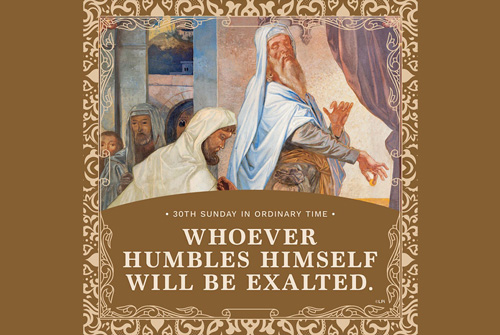
Our gospel passage from Luke 18 is also directed toward humility before God as Jesus directs his parable to “those who were convinced of their own righteousness and despised everyone else.” The Pharisee prided himself on not being like the rest of humanity and specifically not like the tax collector; whereas the tax collector humbled himself before God and begged forgiveness. We find many references to humility before God throughout the scriptures. Two that come to mind are: “….what the Lord requires of you: Only to do justice and to love goodness, and to walk humbly with your God” (Mi 6:8), and the Letter of James (4:10) reminds us to: “Humble yourselves before the Lord and he will exalt you.”
Humility before God means that we recognize ourselves as God’s creation; we are the clay, not the potter. Everything we have comes from God, even our next breath. And as St. Paul often reminds us: What do you have that you did not receive? If you received it, why do you pride yourself that it is yours? Recognizing that everything we have is a gift from God we are called to the virtue of humility before our God.