The Solemnity of Our Lord Jesus Christ, King of the Universe
Reading 1: Ez 34:11-12, 15-17
Reading 2: 1 Cor 15:20-26, 28
Gospel: Mt 25:31-46
This Sunday marks the end of the church’s liturgical year and the end of the Year A cycle of readings. This is the 34th Sunday in Ordinary Time and is celebrated as the Solemnity of Christ the King. The following Sunday begins a new liturgical year with the First Sunday of Advent and the beginning of the Year B cycle of readings.
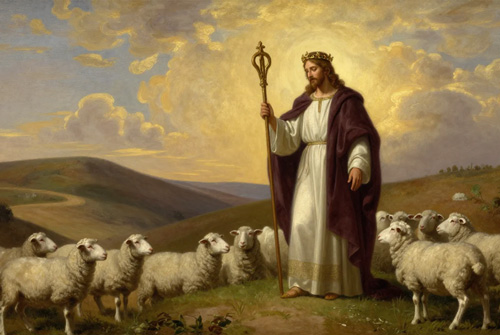
As we are celebrating Christ the King, our readings will reflect the concept of kingship, but do so through the image of a shepherd. And, as a king has authority over his subjects and judges each according to his actions, the theme of kingship in our readings will also lead to the concept of judgment.
Our first reading from the Prophet Ezekiel gives us the comforting image of God gathering all of his scattered sheep throughout the world and tells us that God himself will pasture his sheep and give them rest. At the time of this writing, the Israelite people would have considered themselves to be the “sheep” that God is to gather together as Ezekiel was active during the Babylonian Exile. At this time, the nation of Israel no longer existed; the northern tribes had been overrun by the Assyrians in 722 B.C. and were scattered throughout other territories conquered by Assyria. Then came the Babylonian conquest of the southern tribes and the city of Jerusalem in 587 B.C. The nation of Israel no longer existed, and the various tribes were scattered throughout the known world. So, the image of God gathering all of his scattered people together and giving them rest would have been very comforting. But notice the last verse of our reading: God will “judge between one sheep and another, between rams and goats.” Gathering together may be comforting; but the comfort of gathering together precedes the discomfort of judgment.
Although Ezekiel was writing to the Israelites and intended them to be seen as the “sheep,” we can certainly add ourselves to the “sheep” knowing that we, too, will one day face the same judgment. When our earthly life is ended, we will be “gathered” before the throne of God. But, after the gathering comes judgment. Therefore, Be Prepared!
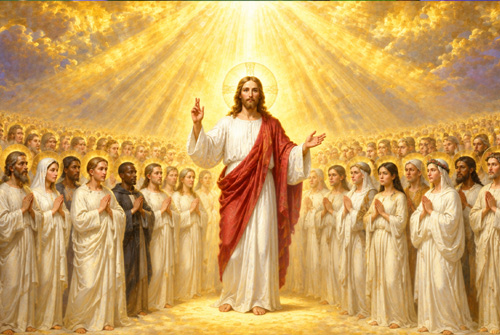
Our second reading from 1st Corinthians and our gospel passage from Matthew hint at the reason for the gathering: Final Judgment! In 1st Corinthians, St. Paul reminds us that when Christ returns, “all will be brought to life,” both the good and the evil, and all will face that final judgment. In our gospel passage from Matthew 25 it becomes clear that we (the Gentiles) are included in this final gathering as “all the nations” will be assembled before Christ upon his glorious throne. In the Jewish mind of the time, there were only two kinds of people in the world: There were Jews, and there was everyone else, and everyone else was “the nations,” the Gentiles that were so despised by the Jews. Therefore, Jew and Gentile alike will face this final judgment together without regard to ethnicity.
If Gentiles are to be judged according to Christian principles, then the implication is that the Christian message must be preached “to all the nations” by the apostles and their successors before the final judgment. If we are to be judged according to Christian principles, then we must be aware of what those principles are, and we are made aware of them through the preaching of those principles by the successors of the apostles (the bishops) through 2000 years of history. So, the message has been preached.
If we were to take this passage from chapter 25 at face value, then it would seem that our salvation would be based on social justice only. In other words, if we feed the hungry and clothe the naked, we will be justified before God. That may be the content of the homilies we will hear this weekend; that we are to take care of those in need! But as Christians, we know that our salvation begins with faith in the Son of God who came into the world for our salvation. Works of charity are also required of us but, as Christians, we know that faith in God and belief in Christ is paramount to our salvation. If salvation is based only on feeding the hungry and clothing the naked, then even an atheist is capable of performing those works of charity, but an atheist will not be saved because of his lack of faith. So, there must be more to this passage than simply social justice.
Notice that Jesus refers to those in need as: “these least brothers of mine.” (25:40). One who does not believe in Christ is not a Christian and, therefore, is not a brother of Christ. The footnotes to this portion of chapter 25 tell us that the hungry and naked, etc. in this chapter refer to Christian missionaries whose role it is to carry the gospel message throughout the world so that, at the final judgment, the Gospel of Christ will have been preached to all the nations. The question then becomes, did those nations receive those preachers and care for their needs or did you reject them? Those who received and cared for the missionaries are the sheep on Jesus’ right; those who did not are the goats on the left.
Itinerant preachers would have been much more prominent in the early years of the church than today as that was the only way the message could be spread (no cell phones, no e-mail, etc.). Those who received the evangelists and accepted the message became Christians and showed their Christian faith through works of charity and social justice. They are the sheep who heard: “Come, you who are blessed by my Father. Inherit the kingdom prepared for you from the foundation of the world” (25:34). Those who rejected the evangelists and their message rejected Christianity, rejected God, rejected Christ, and lost the hope of salvation and were told: “Depart from me you accursed, into the eternal fire prepared for the devil and his angels” (25:41).
The “Golden Thread?” JUDGMENT! We have all heard the message as preached by the church and found in our scriptures, and we are all aware that we will one day face a final judgment. Either prepare ourselves now so that when Christ returns without warning we will be placed on the king’s right; or believe that we have plenty of time and risk being placed on his left.