Twenty-eighth Sunday in Ordinary Time
Reading 1: 2 Kgs 5:14-17
Responsorial Psalm: Ps 98:1, 2-3, 3-4
Reading 2: 2 Tm 2:8-13
Gospel: Lk 17:11-19
Interestingly, the golden thread of this week’s readings is pointed out most clearly in the Responsorial Psalm: “The Lord has revealed TO THE NATIONS his saving power.” I capitalized “to the nations” because any time we hear the phrase “the nations” in the Old Testament, it is a reference to Gentiles. There are only two groups of people in the Old Testament: there are the Jews; and everyone else. And everyone else is a Gentile.
Our first reading is from the 2nd Book of Kings and is centered on the healing of Naaman, the commander of the army of Aram, who was a leper. The kingdom of Aram was located where present-day Syria is found. Naaman, therefore, as an Aramean, was not a Jew but a foreigner, a Gentile. And if we read this story in 2nd Kings 5 we will see that a young Jewish girl who had been captured by the Arameans told Naaman that the prophet Elisha in Israel could heal him of his leprosy. There is more to the story than what I mentioned above and it is well worth a read but it eventually brings us to the point of our reading today. Naaman was healed by bathing seven times in the Jordan at Elisha’s direction (although Naaman didn’t believe that it would heal him). When he was healed, he made the statement we have in our first reading: “Now I know that there is no God in all the earth, except in Israel.” In other words, through the prayers of the prophet Elisha, God revealed his saving power to the nations.
But we also see in this story that Elisha would not accept a gift from Naaman for his healing. God doesn’t charge for his healing power. But Elisha’s servant, Gehazi, couldn’t resist the opportunity to receive what Naaman had to offer so he followed Naaman and accepted the gift. Elisha knew what Gehazi conspired to do and told Gehazi that Naaman’s leprosy would cling to Gehazi and his descendants forever, and Gehazi became “a leper white as snow.” There is no bargaining with God: The way to receive God’s grace and healing power is through faith and prayer.
This reading from 2nd Kings shows us the beginning of a transition in the Jewish mindset concerning God’s mercy. It was previously believed that God’s love and mercy were reserved for Israel alone. That eventually, the day of the Lord, would come and Israel would be glorified, and God would reside in Israel, and all the nations would be punished by God for their infidelity. But in this reading, we see that the Jews were beginning to understand that God’s mercy can be extended even to Gentiles. Another example of a change in the Jewish understanding of humanity’s relationship with God is that it was also a belief of the ancient Jews that prosperity was a sign of God’s favor. A prosperous person was one who was rewarded by God for fidelity. But someone who fell on hard times was one who was being punished by God for infidelity. The Book of Job is a prime example of the transition in the Jewish understanding from the prosperity / destitution, reward / punishment mindset to the understanding that bad things can happen even to good people; and it is not always a punishment from God. It is because bad people sometimes do bad things to good people.
Our second reading from 2nd Timothy also touches on this theme of God’s saving power. St. Paul, the apostle to the Gentiles, tells Timothy (and us) that he bears everything for the sake of those who are chosen so that they too might obtain the salvation that is in Christ Jesus. Those who are chosen are the faithful, whether Jew or Gentile. But he also reminds us that if we deny Jesus, he will deny us, and we may end up like Gehazi.
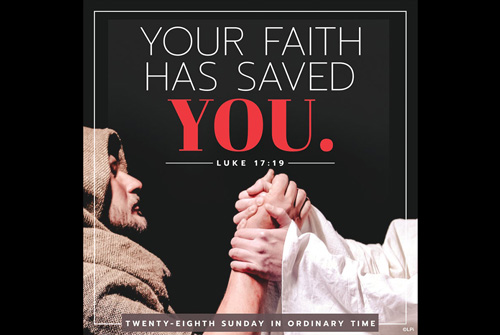
Our gospel passage very clearly carries on the theme of bringing God’s saving power to all people of faith, whether Jew or Gentile, as a group of ten lepers were healed by Jesus, at least one of which was a Gentile Samaritan. And the Gentile who returned to give thanks and glorify God and do homage to Jesus was told: “Your faith has saved you.” This gospel passage, like the parable of the Good Samaritan, is another example of the transition in the Jewish mindset as we have, once again, a non-Jew giving thanks to God for the mercy extended to him as an example to Jewish contemporaries.
God’s love and mercy are directed toward all of us, regardless of ethnicity. The gospel message has been proclaimed to all of us. It is up to us to open our hearts to the power of the Holy Spirit that will bring that love and mercy, and God’s saving power, into our lives.
Reference: Artwork ©LPi