Twenty-sixth Sunday in Ordinary Time
Reading 1: Am 6:1a, 4-7
Responsorial Psalm: Ps 146:7, 8-9, 9-10
Reading 2: 1 Tm 6:11-16
Gospel: Lk 16:19-31
As was the case last week, our first reading comes from the Book of the Prophet Amos. And if we are dealing with Amos, we are dealing with social justice as Amos is often referred to as “the prophet of social justice.” But I think we can carry it a step further and say that our readings this week deal, not only with social justice, but also with the culture of indifference. The indifference Amos found in his society where the people “are not made ill by the collapse of Joseph.” Amos understood that a society where poverty, injustice and indifference to the needs of the poor exist, was a doomed society.
It won’t be necessary to deal with background information on Amos as that was dealt with in last week’s commentary. But, it appears that our “golden thread” this week will be social justice within the culture of indifference; which we should also understand as justice for the oppressed and charity to those in need, and that justice and charity is supposed to spring from our human solidarity – that we are all God’s children and are, therefore, responsible for each other. Amos makes it abundantly clear in this reading that those who live in luxury, lying on their beds of ivory, eating from the flocks and herds and drinking fine wine, have no concern for the “collapse of Joseph.” And that collapse will come! In Amos’ mind, a society with poverty and injustice in its midst is a doomed society, and Amos is warning the people of Israel that their society is about to be conquered and exiled. That prophecy came true in 722 B.C. when the Assyrians overran Israel and exiled most the inhabitants that survived. The only people they left behind were those that the Assyrians felt were of no value to them. And those Jews left behind eventually intermarried with Gentile exiles the Assyrians imported from other areas they had conquered and that intermarriage between Jew and Gentile produced those hated Samaritans we read about in the gospels. They were hated by the Jews of Judah as they were considered unclean because of the Jew/Gentile intermarriage. So, Amos’ prophecy of destruction and exile for Israel came true in 722 B.C. And in Amos’ mind, that destruction came about because of poverty, injustice and indifference to the needs of the poor. The same fate would befall the southern kingdom of Judah in 587 B.C., this time at the hands of the Babylonians.
Our second reading from 1st Timothy doesn’t necessarily follow the theme of social justice but Paul does remind Timothy (and, therefore, us) to pursue righteousness. And righteousness cannot coexist with injustice and poverty. He also reminds Timothy (and us) to “keep the commandment without stain or reproach.” If we want to understand the word “commandment” here from the Jewish standpoint of the Law of Moses which is based on the Ten Commandments, then we see that the first four of the Commandments refer to our relationship with God, and the remaining six refer to our relationship with each other and, therefore, social justice. If we want to interpret “commandment” from the Christian position, our gospel passage makes it clear that our human solidarity requires justice and charity for all.
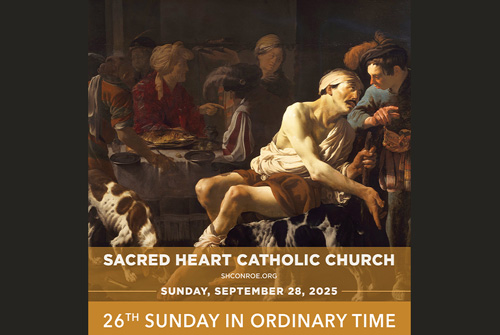
Our gospel passage from Luke 16 is a perfect fit for our reading from Amos and it is one we are all familiar with. Jesus, like Amos, reminds us that wealth and luxury in the face of poverty and injustice produce an incurable disease in society. The culture of indifference is made apparent to us in the example of the rich man and his complete lack of concern for the needs of Lazarus. Although the rich man never gave comfort to Lazarus in life, even in death he asked that Lazarus be sent to give comfort to him. Then, for a moment, disregarding his own selfishness, he asked that Lazarus be sent as a servant to the rich man’s brothers.
We know from history what happened to the Israelites and the Judeans. Is the same fate awaiting us if we continue to disregard the commandment and fail to keep it “without stain or reproach?” Is the same fate awaiting us if we continue to be indifferent to the needs of others in our communities? A very poignant line in our gospel this week occurs when the rich man asks Abraham to raise Lazarus from the dead and send him to the rich man’s brothers that they may repent. And Abraham replies that if the brothers don’t repent because of Moses and the prophets, they will not repent: “even if someone should rise from the dead.” Another prophecy that will be fulfilled in the Resurrection of Christ.
The indifference of the rich man to the plight of Lazarus is the opposite of God’s love. Lazarus was comforted in the “bosom of Abraham;” a comfort that he could have received on earth from the rich man. The indifference of the rich man is a contrast to the love God has for all, especially the poor whom we (and the rich man) are commanded to care for.