A Reflection on the Readings for the Third Sunday in Ordinary Time, January 26, 2025
Reading 1: Neh 8:2-4a, 5-6, 8-10
Responsorial Psalm: Ps 19:8, 9, 10, 15
Reading 2: 1 Cor 12:12-30
Gospel: Lk 1:1-4; 4:14-21
The combined works of Ezra-Nehemiah is probably the best source we have for information about the Jewish religious community after the Babylonian exile, a period referred to as the “Period of Restoration.” The last four books of the Hebrew canon are Ezra, Nehemiah, 1st & 2nd Chronicles, and the combination of those four books was thought to be such a homogeneous historical work that it was believed that all four had been authored by the same person; a person referred to as “The Chronicler.” In the Talmud (the book of Jewish Law), the Chronicler is identified as Ezra. Whoever the author was, the Chronicler’s purpose was to add to Israel’s history things that were passed over in the earlier books of 1st & 2nd Samuel and 1st and 2nd Kings, because it was a belief that emerged in the late Second Temple Period (536 B.C. – 70 A.D.) that the writing of history was a prophetic endeavor – if people understand their history they will be less inclined to repeat that history. In fact, in Greek, a description for the books of Chronicles is “Paralipomena,” meaning “things passed over.” The Chronicler realized that Israel’s political greatness was a thing of the past, but if Israel was to survive, it would have to learn from its past. It must understand why the nation experienced the exile and must learn from it. They must turn away from their sins of the past and return to God. Israel must be a people under God or nothing.
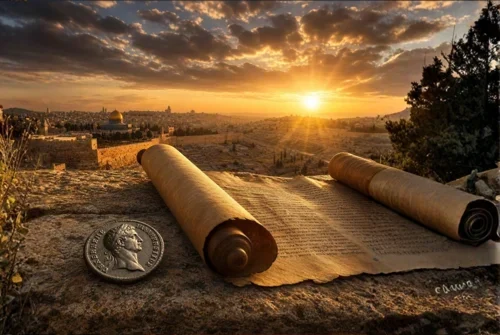
Ezra is a very important person in Israelite history. He was born during the Babylonian Exile, probably in Babylon itself, and devoted the majority of his life to the study of the Torah. He was of the priestly class, but by profession, he was a scribe who became very versed in the Torah by writing scrolls of the Torah. He was well-known as a teacher of the Law of Moses and was well-respected by the Babylonian authorities as well. When the exile ended in 538 B.C. with the defeat of the Babylonians by Persia, many of the Israelites returned to Israel with the intention of rebuilding the land and the temple. However, many of the early returnees lost their zeal for the law and for rebuilding the temple and began to intermarry with the dominant Samaritans of the region.
Some years later, Ezra was given a commission by the Persian king as a high-ranking officer in the land of Israel, and he led a second wave of exiles back to Israel. However, the date of Ezra’s journey to Israel is not known with any certainty. When he arrived, he was shocked to find that the spiritual standards of the people were dangerously low as they had fallen under the influence of the Samaritans, and the younger generations were completely unaware of their spiritual heritage. Ezra made it his goal to revive observance of the Law of Moses in Israel, and our first reading this week is an example of that attempt at revival. “Ezra the priest brought the law before the assembly” and stood before them from morning until midday reading the law to the people. Then, that assembly “bowed down and prostrated themselves before the Lord,” acknowledging the presence of God in his word.
In Jewish tradition, Ezra is regarded as a second Moses because it was Ezra who brought the law to the people of the Restoration. Because of his efforts and his success in this endeavor, the Jews accept no books into the canon written after the time of Ezra, and as Ezra is the lawgiver to the restored community, the law is complete with Ezra, and nothing further needs to be added. When Christ came into the world, the law was not added to or subtracted from but was changed. Jesus came not to destroy the law but to fulfill it. With Christ, the law became a living thing, not simply a code of cold, hard rules. No longer does the law say simply: Thou shalt not kill. Now the law says: Love your neighbor as yourself; turn the other cheek; forgive as God has forgiven you.
In our second reading, St. Paul reminds us that each of us is given special talents by God, and we are meant to rejoice in those talents and to use them for the common good of the community. More specifically, we are not to be jealous of the talents of others and are not to attempt to mimic the talents of others.
Our gospel passage from Luke begins with a prologue addressing the gospel to “Most excellent Theophilus” (literally meaning, “Friend of God”). Luke explains that his purpose in writing this gospel is not to give new revelation but to establish the reliability of what Theophilus and others have already heard about Jesus and his teachings. Luke’s purpose is to present what is already known in an orderly fashion.
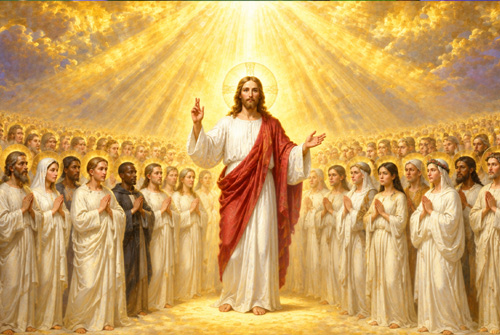
Our gospel then switches to chapter 4, in which Jesus attends the synagogue on the Sabbath. In our first reading, we have Ezra standing before the assembly proclaiming God’s word in the Law of Moses; in our gospel, we have Jesus proclaiming God’s word through the prophet Isaiah, “and the eyes of all in the synagogue looked intently at him” …. “and all were amazed at the gracious words that came from his mouth.” Jesus then made a profound statement: that what had just been proclaimed as the words of Isaiah had just been fulfilled in the person of Jesus in the presence of this assembly. Jesus declares himself to be the anointed one who is to proclaim liberty, etc. As in our first reading, it appears that the assembly acknowledged the presence of God in his word and in the presence of Jesus. But if we read further into chapter 4, we will see that the original amazement at Jesus’ words turned into jealousy on the part of the assembly because they were familiar with Jesus as the son of the carpenter – where did he get all this knowledge?
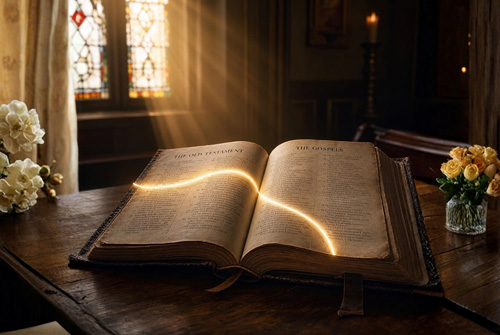
So, what is our “golden thread” this week? In both our Old Testament reading and in our gospel, we have a community assembled for the purpose of hearing the proclamation of God’s word, and in that proclamation, the community recognized the presence of God and acknowledged that presence. That should be our community as well, whether we see that community in the fifty century B.C., in the first century A.D., or in the 21st century. That is our church. The church is one, holy, catholic, and apostolic (the “Marks of the Church”), but it is made up of individuals, the building blocks of the assembly that are not always holy. It is up to us, through faith, prayer, and sacraments, to make ourselves less unholy building blocks.
References:
Blenkensopp, Joseph; Isaiah 1-39 (Anchor Bible Series # 19), (New York: Doubleday, 2000), 74.
New American Bible; The Catholic Study Bible; (Introduction to the Book of Ezra), (New York: Oxford University Press, 1990), 476 ff.