First Reading: Dt 4:32-34, 39-40
Responsorial Psalm: Ps 33:4-5, 6, 9, 18-19, 20, 22
Second Reading: Rom 8:14-17
Alleluia: Rv 1:8
Gospel: Mt 28:16-20
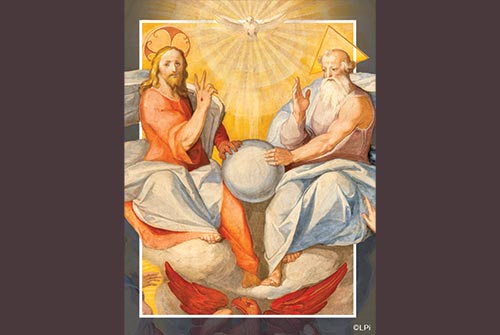
The Holy Trinity is a mystery of faith that is inaccessible to reason alone. It is a mystery that cannot be known unless it is revealed by God. God has left traces of his Trinitarian being in his work of creation and the revelation of the Old Testament and has confirmed that revelation in the Incarnation of God’s Son and the sending of the Holy Spirit (cf CCC: 237).
This Sunday, we celebrate the Solemnity of the Most Holy Trinity, and we should find in our readings this week a reflection of that foundation of our faith; that God exists as a Trinity of Father, Son and Holy Spirit.
Our first reading is from the Book of Deuteronomy. The title of this book means “second law” but, in reality, Deuteronomy is not a new law or a second law, but a re-presentation and expansion of the law proclaimed on Mt. Sinai in the Book of Exodus. The dominant characteristic of the Book of Deuteronomy is its oratorical style; containing a series of discourses by Moses reminding the people of their covenantal relationship with God that was established on Mt. Sinai, and the laws that govern that relationship. Our reading from chapter 4 is just such an exhortation by Moses reminding the people that they are witnesses to the mighty power of God; they heard the voice of God speaking from the midst of fire; they witnessed the ten plagues God brought upon the Egyptians in redeeming the Israelites from slavery in Egypt (see Exodus 19 & 20). “This is why you must know, and fix in your heart, that the Lord is God in the heavens and on earth below, and that there is no other” (Dt 4:39). Stated simply; Moses was telling the Israelites that, because of the marvelous revelations of God they had experienced, revelations that no other nation had experienced, they should follow God’s commands out of obedience to the God that had revealed himself to them.
At this point in the history of the Israelites’ relationship with God there is no real concept of the Holy Trinity, no understanding of the Holy Spirit, or that God will, at some point in time, enter the physical world in the human person of Jesus. God was understood to be ethereal, outside the realm of human experience. It is that all-powerful, creator God that Moses was directing their attention to and reminding them that they were in a covenantal relationship with God that required the carrying out of the laws prescribed by God. The keeping of God’s commandments was to have been the people’s response, in thanksgiving and in obedience, to God for his deliverance of the people from the bondage of Egypt. Therefore, our first reading draws our attention to God the Father.
Our second reading is, of course, from the Christian era and, specifically, from a famous passage from chapter 8 of the Letter to the Romans in which St. Paul draws attention to the Holy Spirit. The apostles were, at this time, spreading the Christian faith throughout the known world and they were able to do so only because of the Pentecost experience when the Holy Spirit descended upon the apostles, and they were led into all truth. St. Paul reminds his readers that, like the apostles, baptized Christians have received the anointing of the Holy Spirit and enjoy a new relationship with God because of the presence of the Holy Spirit within them. Those who have received the Spirit of God are sons (and daughters) of God and are heirs of God and joint heirs with Christ. It is the Spirit of God, the Holy Spirit, that enables us to participate in the life of God as his adopted children crying out, “Abba, Father.” Therefore, our second reading draws our attention to God the Holy Spirit.
Our gospel this week is the commissioning of the apostles according to the Gospel of Matthew. This is the only gospel in which the apostles were specifically commissioned to baptize; “…in the name of the Father, and of the Son, and of the Holy Spirit.” In addition, Jesus made it clear that the universal authority of the heavenly Father, over heaven and earth, has been given over to the Son. And, as the apostles were being commissioned for a specific purpose, the implication is that that authority has been passed on by Jesus to the apostles to baptize, and to teach all that they received from Jesus.
The gospel this week draws attention to the universal authority of God the Son and to the church he formed to carry on his mission through the apostles and their successors throughout 2000 years of history. And to the Trinitarian Formula by which we are all baptized: “In the name of the Father, and of the Son, and of the Holy Spirit.”
Reference: ©LPI