Fifteenth Sunday in Ordinary Time
Reading 1: Is 55:10-11
Responsorial Psalm: Ps 65:10, 11, 12-13, 14
Reading 2: Rom 8:18-23
Gospel: Mt 13:1-23
There is a shorter version of the gospel that may be proclaimed this week, but I eliminated it above to save some space.
Our first reading this week is from chapter 55 of Isaiah which is entitled: “An Invitation to Grace.” We get only a small portion of that chapter in our reading, but it is probably important to understand the context from which our reading comes.
Chapter 55 of Isaiah was probably written toward the end of the Babylonian exile, so it reflects a time when the nation of Israel and the temple in Jerusalem had been destroyed by the Babylonians and the people had been captives in Babylon for several decades. Consequently, it reflects a time when the people felt they had been abandoned by God. But through the prophet, in this chapter, God was extending an “Invitation to Grace” and a promise of restoration to Israel.
Chapter 55 begins with: “All you who are thirsty come to the water…I will renew with you the everlasting covenant, the benefits assured to David.” And what are the benefits assured to David? You will find those benefits in 2 Samuel 7: 10-15. I’ll let you look them up for yourself rather than print them out in this reflection but, they end with the words: “Your house and your kingdom shall endure forever before me; your throne shall stand firm forever.” Therefore, the author is assuring the people that, although they have suffered at the hands of the Babylonians, God has not withdrawn his promise that the nation of Israel will endure forever.
The author of this chapter of Isaiah is reminding the people that they have been glorified by God as the “Chosen People” and is imploring them to turn back to God and to: “Seek the Lord while he may be found.” Because God’s grace is poured upon the earth like rain, and his Word, spoken through the prophets at the time of this writing but eventually through Christ several hundred years later, will not return to God until the Word has achieved: “the end for which I sent it.” Although the people have suffered through the exile, God has not abandoned them and will again restore the benefits assured to David. The author uses the analogy of rain and seed to make his point in the same way that Jesus uses the parables of seed, rocky ground and thorns in our gospel passage. We find that same analogy in our Responsorial Psalm: “The seed that falls on good ground will yield a fruitful harvest.”
Our second reading from the Letter to the Romans comes from a section of that letter entitled: “Destiny of Glory.” In this section of chapter 8, St. Paul confronts the presence of suffering in the lives of Christians in much the same way Isaiah confronts the suffering of the Israelites in their captivity in Babylon in our first reading. But what is particularly distinctive about this passage is that St. Paul includes all of creation in the suffering. All creation, not just humanity, is subject to decay and corruption. All things come into existence; they grow to maturity and eventually die and decay. They are subjected to that corruption: “Because of the one who subjected it.” That reflects back to Genesis 1:26 wherein man was given dominion over all of creation: “over the fish of the sea, the birds of the air…..” But, because of the sin of Adam, the earth was cursed (Gn 3: 17-19), was subjected to corruption and decay, and henceforth yields its fruits only through sweat and toil. Considering our modern concern for the environment and global warming which may be the result of human activity, this passage could be considered particularly poignant.
According to this passage, because of human sin, the suffering of non-human creation through corruption and decay is directly related to the suffering of humanity brought about by sin. But, according to St. Paul, all of creation will participate in salvation along with humanity and will: “share in the glorious freedom of the children of God.” In other words, all of creation, human and non-human, will eventually be brought back to its original condition as found in the Garden of Eden. St. Paul reminds us that Christians have received the “first fruits” of salvation, the Holy Spirit. Therefore, humanity awaits the adoption and redemption of our bodies, and all of creation will participate in that redemption. Consequently, the sufferings of the present, like the sufferings of the Israelites in captivity, are as nothing compared to the glory that is to be revealed for us.
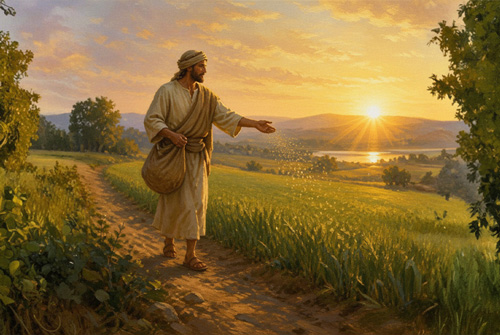
In our gospel passage from chapter 13 of Matthew, Jesus teaches the people using the Parable of the Sower. Toward the end of the passage, he also gives the explanation of the parable to the disciples so there is no need to expand on that meaning here. But there are some interesting points in this passage for our consideration.
In Jewish tradition, when a Rabbi prepared to teach the people, he sat down. It was understood that when he “sat down and opened his mouth,” he was preparing to teach; not like modern professors who usually stand in front of the class when teaching. Here, we have Jesus sitting in the boat while the crowd stood along the shore, so it would have been obvious to the people that he was about to teach.
Jesus often taught in parables which should be understood as illustrative comparisons between Christian truths and events of everyday life. Jesus knows the mysteries of the kingdom of heaven, but human language falls short in passing those mysteries on to others. As Christian truths would have been difficult for the people of the time to understand, comparing those truths to events of everyday life would make them more understandable.
When the disciples question Jesus about his use of parables Jesus answers by saying that the knowledge of the mysteries of the kingdom of heaven has been granted to the disciples, but not to most of the people. Knowledge of those mysteries is a gift from God, and part of that knowledge is also recognition that the kingdom has come in the person of Christ. That gift has been given to the disciples through the Holy Spirit, but it will be up to them to pass that knowledge on to the people through their preaching and writing. To those who accept that teaching: “More will be given and he will grow rich.” Those who do not fully accept that teaching, what little they have will be taken away; like seed that falls on shallow ground: They look but they do not see; they hear but they do no listen. “Whoever has ears ought to hear;” and not reject.
What about the Golden Thread? It might be found in connecting these two passages from our readings this week:
“My word shall not return to me void, but shall do my will, achieving the end for which I sent it”.
“Whoever has ears ought to hear.”