Reading 1: Dt 8:2-3, 14b-16a
Responsorial Psalm: Ps 147:12-13, 14-15, 19-20
Reading 2: 1 Cor 10:16-17
Gospel: Jn 6:51-58
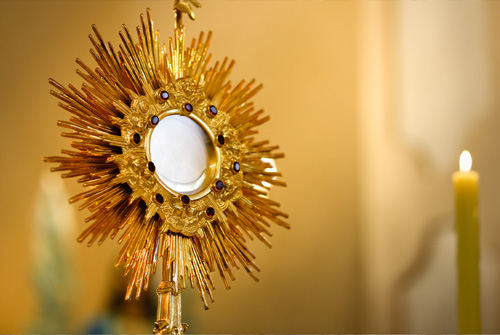
This Sunday we celebrate the Solemnity of the Most Holy Body and Blood of Christ, also known as Corpus Christi Sunday. It is the celebration of the Eucharist, the source and summit of our faith. In the most Holy Sacrament of the Eucharist, the Body, Blood, Soul, and Divinity of Christ are truly and substantially contained, rendering Christ tangibly present to his people under the physical elements of bread and wine.
Our readings this week are very Eucharistic in nature and a cursory reading of them will make that apparent. In addition, our readings should also draw attention to the connection between the Old and New Testaments. The Old and the New are not two unconnected books, as is indicated by the expression: “The New is hidden in the Old, and the Old is revealed in the New.”
In our first reading from Deuteronomy, Moses reminded the people (and us) that God cared for his people on their journey from Egypt to the Promised Land. God “fed you with manna, a food unknown to you and your fathers” and “brought forth water for you from the flinty rock.” In the Old Testament, Egypt represents a life of slavery; the Promised Land represents a life of peace and happiness. The desert experience of Exodus is the land between slavery and paradise. And we are told in this passage that God cared for and protected his people on this desert journey from slavery to paradise and provided them with food and drink.
For us in the 21st century, Egypt symbolically represents a life of slavery to sinful ways and habits; the Promised Land represents that state of existence we refer to as heaven. The life between the two is the life of trial and tribulation we are called upon to endure during our earthly existence. The message of this passage from Deuteronomy for the 21st century is that we, too, are on a journey from sinfulness to holiness, from slavery to sanctity, and we cannot rely on our own resourcefulness to sustain us on that journey. We, like the Israelites in the desert, need God’s help to successfully complete the journey. We need to hear and reflect upon the Word of God; we need to participate in and receive the sacraments of the church that Christ instituted for the forgiveness of our sins; and we need the sustenance provided by the Body, Blood, Soul, and Divinity of Christ provided by the Eucharist.
Moses led the people in the desert; God provided them with a covenant, and laws to order their lives, and spiritual food and drink to sustain them. The church leads us on our spiritual desert experience of daily existence; God provides us with a NEW and everlasting covenant in the Blood of his Son, and the nourishment of the real presence of his Son in the Eucharist. The new covenant of the New Testament is hidden in the old covenant of the Old Testament.
Our gospel this week is from the “Bread of Life” discourse in chapter 6 of the Gospel of John in which Jesus makes it abundantly clear that the Eucharist is truly his flesh and blood. I do not know how anyone could possibly interpret this chapter any other way: “For my flesh is true food, and my blood is true drink.” Not only does Jesus make it clear that the Eucharist is his flesh and blood, but he also makes it clear that if we do not believe these words and receive the Eucharist with pure and contrite hearts, there will be no life within us.
Without the manna in the desert, the Israelites would have had no life within them. They participated in the gathering of manna as a community because it was their sustenance. Without the Eucharist, we have no life within us, and as St. Paul reminds us in our second reading, we participate in the Eucharist as a community because it is our sustenance. “We, though many, are one body, for we all partake of the one loaf.”