A Reflection on the Readings for the Fourth Sunday of Lent, April 21, 2024
Reading 1: Acts 4:8-12
Responsorial Psalm: Ps 118:1, 8-9, 21-23, 26, 28, 29
Reading 2: 1 Jn 3:1-2
Alleluia: Jn 10:1
Gospel: Jn 10:11-18
This Sunday, the Fourth Sunday of Easter, is also known as “Good Shepherd Sunday,” and a reading of our gospel for this Sunday will make that apparent.
Our first reading this week is from St. Luke’s “Acts of the Apostles” and is an excerpt from Peter’s speech before the Sanhedrin. The context of this speech (if you read back into chapters 3 & 4) is that Peter and John cured a crippled beggar at the gate of the temple and were proclaiming that it was only by belief in the name of Jesus that the man was healed. They were then taken into custody and held overnight to be tried before the Sanhedrin the next morning.
The speech itself is self-explanatory if you read through it in chapter 4 but some significant points should be made. Peter made this statement: “There is no salvation through anyone else, nor is there any other name under heaven given to the human race by which we are to be saved” (4:12). The Romans, and those Jews who were Roman sympathizers, were taught that the emperor was to be considered a god and savior (see footnotes to 4:12). With this statement, Peter was denying any deity for anyone other than Jesus and affirming that salvation comes only through Jesus, and it is only through the name of Jesus that the cripple was healed. That would have been a direct affront to the Romans, and those who collaborated with them, who believed the emperor was a god.
In addition, Peter quoted Psalm 118 (our Responsorial Psalm this week) claiming that Jesus is the stone rejected by the builders which has become the cornerstone. At that time, the elders of the Sanhedrin would have been considered the “builders” and, therefore, Peter’s statement affirms that it is those elders who had rejected the cornerstone and, further, their action in doing so was prophesied hundreds of years before in this Psalm which comes from their own scriptures; again, a direct affront to the “builders.”
Peter and John were released by the Sanhedrin and ordered not to speak in the name of Jesus in the future, but they replied: “It is impossible for us not to speak about what we have seen and heard” (4:20).
That was the context of our first reading but the importance of it for us is that it shows the development of the church in the first century through the preaching of the apostles, and that is what we are celebrating during the Easter season. The Acts of the Apostles is essentially the history of the development and spread of the church in the first century and it is well worth the time to read this book. That development and spread began in the Jewish communities of Jerusalem but spread far and wide when persecution of Christians began in Jerusalem and the apostles spread throughout the known world to proclaim the gospel. One of those apostles was St. Paul and his letters tell us about his work of spreading of the gospel in Gentile communities. And none of this development and spread would have been possible without the gift of the Holy Spirit on Pentecost. Be aware of the power of that Spirit when reading this book.
Our second reading is from the 1st Letter of St. John, which is often referred to as a “love letter” because of the emphasis this letter places on the love God has for his people, and that love is made apparent to us through the sacrifice of Christ. Our knowledge of that love and of that sacrifice comes to us through the authentic teaching of the apostles and not through various heresies that were spreading in the early church. One of the purposes of the First Letter of John was to combat those early heresies (see the introduction to this book in your bible). The authentic teaching of the church demands of us true Christian fellowship. For a true Christian, knowledge of God and love for one another are inseparable; one cannot claim to love God while hating one’s neighbor. If we live in that Christian fellowship according to the revelation of the apostles then, as St. John puts it: “We are God’s children now” (3:2). Full knowledge of God will eventually be realized in us by the lives we presently live so that when we see God, “We shall be like him, for we shall see him as he is” (3:2).
Our gospel passage this week is from Jesus’ “Good Shepherd” discourse from chapter 10 of the Gospel of John. It is an analogy using sheep to represent the people of God and a lightly veiled attack on the Pharisees who should have been the teachers and, therefore, the shepherds of the people but have failed to live up to their responsibilities. At the time of this discourse, those who heard it would have understood it in a way that we may not be inclined to understand it today. Many different flocks of sheep could have been contained in one sheepfold, but when the various shepherds came to lead their sheep out to pasture, the sheep would follow only their own shepherd. The different flocks would separate and follow their specific shepherd and would not follow the voice of a stranger.
Our passage begins with Jesus saying: “I am the good shepherd,” (10:11) implying that the Pharisees and elders were not good shepherds but were “hired men” and the sheep do not recognize the voices of the hired men. Furthermore, the hired men do not recognize the voice of Jesus; but the people of God who have followed Jesus’ teaching do recognize his voice and follow him: “I know mine and mine know me” (10:14).
Jesus also makes the statement: “I have other sheep that do not belong to this fold. These also I must also lead, and they will hear my voice, and there will be one flock, one shepherd” (10:16). It is not clear whether “other sheep” here is referring to Gentiles or possibly to Jews dispersed throughout the known world (or to both), but it is clear that God intends that there will eventually be one flock, one Christian church, and one shepherd.
The “Golden Thread” this week? The love of God was given to us through Jesus Christ and the Holy Spirit and administered to us in the teaching of the apostles in the Christian church Jesus established. It is belief in the name of Jesus, the Good Shepherd, that healed the cripple and will lead us to salvation.
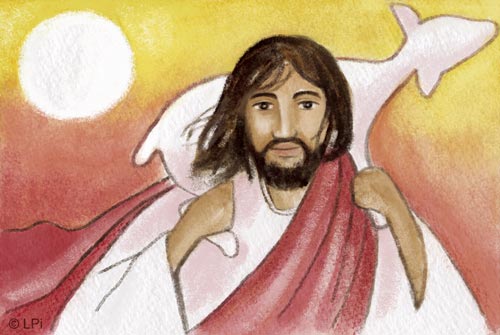
Illustration: © Lpi