A Reflection on the Readings for the Fifth Sunday in Ordinary Time
First Reading: Is 58:7-10
Psalm: Ps 112:4-5, 6-7, 8-9
Second Reading: 1 Cor 2:1-5
Alleluia: Jn 8:12
Gospel: Mt 5:13-16
Most scholars seem to agree that the last ten chapters of Isaiah (56-66), with the exception of a few passages here and there, were written at the end of the Babylonian Captivity (597-538 B.C.) and were directed to the returning exiles who are now the Purified Remnant of Israel. Purified through their chastisement at the hands of the Babylonians, they are now redeemed by God and called to a new way of life that will bring honor and glory to God and prosperity to those who abide by God’s precepts.
As it was the failure of the people and their kings to abide by God’s law that caused them to fall into the hands of the Babylonians, most of these chapters admonish the people to return to God in their actions, not just by their words. God requires observance of the law, observance of the Sabbath, and, above all, the practice of social justice toward the widow, the orphan, the oppressed and the alien in your midst. “Then your light shall break forth like the dawn, and your wound shall quickly be healed.” It is through the just and upright conduct of this purified remnant that God’s glory will be made manifest to the world and the returning exiles will live prosperously on the land and become the envy of all nations. This remnant is to be the light of the world.
When we read the Old Testament, we tend to think of it as documents written 2000 to 3000 years ago about the ancient Jews and the nations around them with little, if any, relevance to us in the modern world. But there is a very tangible relationship between the Old and New Testaments which is summed up in the expression: The New Testament is hidden in the Old Testament, and the Old Testament is revealed in the New Testament. Ideally, we will find that relationship in our Sunday Masses when we look for the “golden thread” that binds the Old Testament reading to the gospel. I think we find that relationship this week in the concepts of “light” and “salt.”
Salt, of course, should be seen as a preservative; and light as enlightenment. If we look for the relationship of light and salt in our first reading, we see the author of this portion of the Book of Isaiah is calling on the Israelites who have returned from captivity in Babylon to preserve the law given to them by God through Moses. And, that law required them to protect the oppressed and the homeless, the widows, the orphans, and the aliens in their midst. In other words, the law requires social justice. Specifically, the law states: “Do not harvest every stalk of grain from your fields. If you miss a sheaf, leave it there for the widows and orphans” (Dt 24:19-20). Deuteronomy 15 tells us that every 7th year – the Sabbatical Year – all debts must be forgiven, and all slaves set free. Every Sabbatical Year the land must be left fallow; no plowing, planting or reaping. Let the land produce what it will, and what it produces is for the widows and orphans. If the Israelites adhere to these precepts, they will preserve the law and will be a light to the nations around them and God’s glory will be made manifest through the Purified Remnant of Israel.
In our gospel passage, Jesus addressed his disciples, referring to them as “the salt of the earth.” They are to influence the world around them by their deeds and their witness and by that witness, they will be as noticeable as “a city set on a mountain.” But, by extension, he is addressing us as well as we are told that we are to be the light of the world and we are not to hide that light. It is to shine forth in us to manifest God’s glory. Therefore, we should see ourselves as the purified remnant and that we, like the ancient Jews, are called to be the salt of the earth and the light of the world, to manifest God’s presence by our conduct and observance of God’s law in our lives. But Jesus also warns us that if the salt loses its taste or the light goes out, we are good for nothing but to be thrown out and trampled underfoot.
As an example of the conduct expected of us, St. Paul tells us in our second reading that his teaching and conduct are “not with persuasive words of wisdom, but with a demonstration of Spirit and power.” He doesn’t come in pomp and circumstance but with the humility of total trust in God and trust in the message he proclaims.
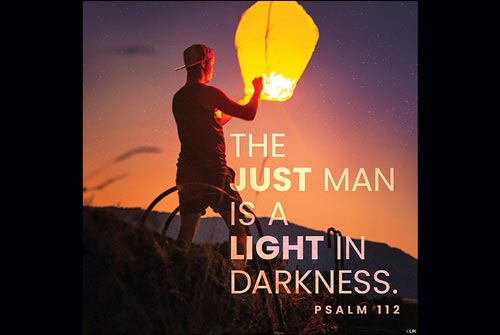
Our Responsorial Psalm continues the theme of justice in conduct as: “The just man is a light in darkness to the upright.”
Therefore, our golden thread this week is that we, like the purified remnant, have been redeemed by God, but for a purpose. And if we hope to spend eternity in the happy presence of God, we must fulfill that purpose. If we fail in that purpose, we reject God; and if we reject God, he cannot save us. Think of the parable of Lazarus and the rich man in chapter 16 of Luke. The God, who created you without your help, cannot save without your help. We, like the ancient Jews, are called to be the light of the world.