A Reflection on Readings for the Third Sunday in Ordinary Time, January 22, 2023
First Reading: IS 8:23-9:3
Responsorial Psalm: PS 27:1, 4, 13-14
Second Reading: 1 COR 1:10-13, 17
Gospel: MT 4:12-23
Chapters 7-12 of Isaiah are often referred to as “The Book of Immanuel,” and the overall message of these chapters is eventual messianic salvation. For example, in chapter 7 we have that famous reference to the coming messiah that we discussed a few weeks ago: “The virgin shall be with child and bear a son and shall name him Immanuel” (7:14). Mixed in with the prophecies of salvation in these chapters are prophecies of punishment for Israel and Judah (and the nations around them) and our short first reading this week from chapters 8 & 9 has a little of both.
Dating the various passages in Isaiah is very difficult because the book covers about 200 years. Much of the earlier chapters were probably written (or dictated) by Isaiah, but later chapters were written by disciples of Isaiah or disciples of his disciples. In addition, those disciples may have re-written earlier passages or added to them, so it is difficult to determine what is true prophecy and what may have been written after an event occurred to make it look like it was prophesied before the event. Our reading this week from chapters 8 & 9 is a difficult one to try to interpret, but I’ll give it my best shot.
Our passage this week begins with: “First the Lord degraded the land of Zebulun and the land of Naphtali.” If we accept that Isaiah received his call to prophesy “in the year that Uzziah died” (742 B.C.), then this verse would refer to a historical event that occurred during the lifetime of Isaiah about 732 B.C. with the beginning of the Assyrian overthrow of the northern kingdom of Israel which was completed in 722 B.C. Apparently, the first two tribal areas overrun by Assyria were Zebulun and Naphtali. (It should be noted that when you read Old Testament prophecy, that northern kingdom is often also referred to as Samaria or as Ephraim; three different names, which can be confusing if we don’t recognize they all refer to the same territory). When the Assyrian conquest was complete, those that survived the onslaught were deported into other Assyrian territories, and Gentiles were imported into what used to be Israel (Samaria / Ephraim). It is the Assyrian conquest of Israel that resulted in the “Lost Tribes of Israel;” ten tribes deported and assimilated into other cultures in other nations, losing their Jewish identity. But, as we are in the Book of Immanuel, we should also be looking for references to messianic salvation, and we have that in our next couple of verses: “But in the end, he has glorified…the District of the Gentiles.” And: “Those who walked in darkness have seen a great light.” Those verses would probably be in reference to the Gentiles that occupied Samaria after the Assyrian conquest. If we interpret those lines that way, then we have a reference to a great savior who will bring light (salvation) to the Gentiles who had previously “walked in darkness.”
Our reading from Isaiah ends with verse 3, but if we read on to verse 5, we have another reference to that savior: “For a child is born to us, a son is given us…They name him Wonder-Counselor, God-Hero, Father Forever…” which relates directly back to the passage from chapter 7 mentioned above. The question raised by these passages concerning the child is: who does this refer to? Christianity, of course, has always recognized these passages as referring to Christ, but, as mentioned in a previous commentary, Jewish scholars differ in their interpretations of who this child will become. But at the time of the composition of these references to the child, it would probably have been believed that the child would grow up to be the next good king of Judah (the southern kingdom) who will be the “Wonder-Counselor, God-Hero,” etc. And that next good king was Hezekiah, who was probably born around 732 B.C., about the time the conquest of Israel began. Therefore, our golden thread this week should relate to a savior who will bring light (salvation) to all people, not just the Jews.
Our Responsorial Psalm reflects that theme with: “The Lord is my light and my salvation.”
Our gospel this week reflects back on our reading from Isaiah. We are told that, with the arrest of John the Baptist, Jesus withdrew to the regions of Zebulun and Naphtali, the regions that Isaiah told us had been “degraded” by the Lord. That degradation probably refers to the conquest of those regions by the Assyrians, which included the deportation of most of the Israelites living in those regions and the importation of Gentiles. Consequently, those regions became the “Galilee of the Gentiles” as they were populated by Gentiles who “dwell in darkness” because they have not known the God of Israel. But to those Gentiles who dwell in darkness, a great light in the person of Jesus (Emmanuel) has come with the message of salvation. That message is: “Repent, for the kingdom of heaven is at hand,” and salvation is available to the Gentiles as well.
Notice the contrast here between the darkness of the arrest of John the Baptist (which foreshadows that which will follow later with the arrest of Jesus) and the light of salvation announced by Emmanuel (which means God is with us). There is darkness, but there is also hope (the light of salvation). A message we should always keep in mind because we are surrounded by darkness in our world; not only the darkness of sin but the darkness of indifference to that sin that manifests in indifference to the sin of violence, terrorism and hatred for those who do not agree with us politically or morally. As Christians, we are required to manifest hope, not darkness.
There is an interesting point about the Gospel of Matthew in reference to the kingdom. In Matthew, the kingdom is always referred to as the “kingdom of heaven,” never the “kingdom of God” as in the other gospels. Matthew’s gospel is addressed primarily to Jews who considered God’s name to be too sacred to even be spoken. Consequently: “kingdom of heaven” as opposed to “kingdom of God.”
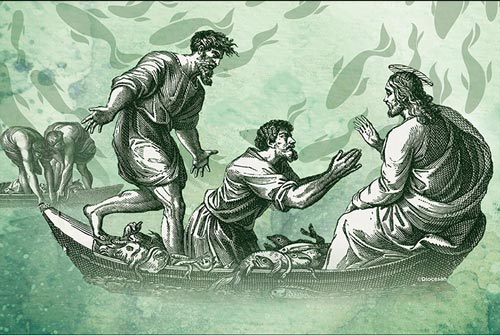
Our gospel continues with the calling of the first disciples, who will be called to follow in the footsteps of Jesus (Immanuel) by proclaiming the gospel of the kingdom and curing every disease and illness among the people. They, of course, are called to carry on the work of Jesus after his Ascension. At the very end of Matthew’s gospel, those disciples are commissioned to make disciples of all nations by baptizing them and teaching them (M.T. 28:19). Throughout the gospels; these men are presented to us as disciples, those who are learning as students. But with the commissioning at the end of Matthew’s gospel, they should now be considered graduates/apostles, those who are now sent into the world to carry on Jesus’ work. They are the first bishops of the church, but the work of proclaiming the gospel doesn’t end with them; it is our responsibility as well.