Twenty-third Sunday in Ordinary Time
Reading 1: Ez 33:7-9
Responsorial Psalm: Ps 95:1-2, 6-7, 8-9
Reading 2: Rom 13:8-10
Gospel: Mt 18:15-20
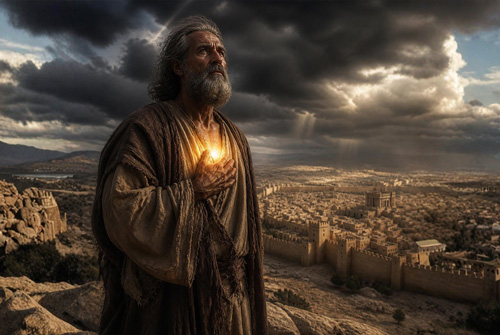
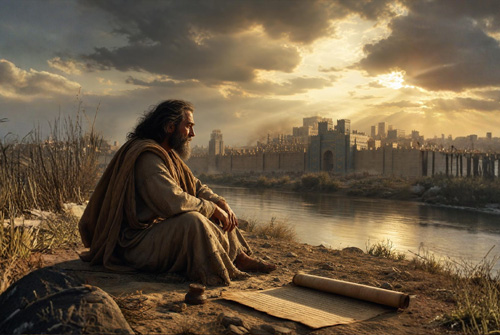
Ezekiel is unique among the prophets of Israel as he was the only one called to the prophetic office outside of the Holy Land; while he was an exile in Babylon. We generally date the Babylonian Exile from 587 to about 539 B.C., but Jerusalem actually fell to the Babylonians about 10 years earlier around 597 B.C. when the Babylonians laid siege to Jerusalem and forced the city into submission. Some of the elite of the city were exiled at that time, including Ezekiel, but the city and temple were spared, and Jerusalem was ruled by Babylon through a proxy king. Ezekiel was a temple priest in Jerusalem at the time and was one of the first to be exiled into Babylon. About 587, the people of Judah rose up against Babylonian rule and Nebuchadnezzar of Babylon destroyed the city and the temple and either killed or exiled most of the remaining people. Ezekiel was already an exile when this happened, and it was during this 10-year span that Ezekiel received his call to prophesy.
During these early years in Babylon, Ezekiel’s prophesy centered on Israel’s past and present sins and that, because of those sins, Israel would be punished with the destruction of the city of Jerusalem, destruction of the temple, and the exiling of those remaining in Judah. Of course, no one believed him, until 587. After 587, Ezekiel’s message changed to a promise of salvation through the exiles that would eventually return to Judah as a purified remnant of Israel and would rebuild, producing a restored Israel under the rule of God and free of sin and evil. His famous chapter 37 of the vision of dry bones is an example of this vision of a restored Israel.
Before 587, the Jewish religion was based on the temple. The temple was the center of worship, and it was the temple to which the people went to offer sacrifice. After the destruction of the temple in 587, the people had lost the center of their worship and were in danger of losing their religion entirely. Ezekiel essentially saved the people from giving up their faith by focusing on worship practices that could be performed outside the temple such as liturgy, observance of feast days, study of the Law, ritual circumcision of their male children, etc. Consequently, Ezekiel is often called “the father of Judaism” and is credited with saving the Jewish religion in the aftermath of the exile.
Our first reading is a harsh one; but it is the “golden thread” this week. It essentially says that Ezekiel — and by extension all of us – are called to draw attention to the sins of others. That’s not a task that any of us would relish (let he who is without sin cast the first stone). But if Ezekiel doesn’t follow this command, then he will be held accountable for the sins of those he was called upon to reproach. We would hope that we would not be held to the same standards as a prophet and have to pay for the sins of others. But if we fail to call attention to sin and evil in our midst then we become complicit in that sin and all of society suffers for the evil that we overlook. The world today is full of sin and evil and we are well aware of it; lying, cheating, racism, exploitation of the poor, sexual sins against children, adultery, etc., the list goes on and on. But we, too often, consider these behaviors as simply ingredients of modern society. And if we do not speak out against them then we are tacitly accepting them in our midst. So, we really are held to the same standards as Ezekiel. And, as St. Paul tells us in our second reading, it is our duty to love one another; and what greater love can we show one another than to combat the sin and evil in our midst?
Our gospel this week carries on this theme of combatting evil in our midst. Go privately to a sinner so that he knows that someone is aware of his behavior. If that doesn’t work, take witnesses so he knows that many are aware of his behavior. If two or three pray for the conversion of that person, God will hear that prayer and know that you have tried. If that doesn’t work, take it to the church and let the church bind or loose.
We are conditioned to think that God is the only dispenser of punishment for sin. But sometimes the sin carries its own punishment. If a sinner knows that others are aware of his behavior, that awareness puts a wedge between the sinner and the community. That awareness produces anxiety, and that anxiety is a punishment for sin. Imagine what it would be like to know that others are aware of your sinful behavior. The more that are aware of the behavior the more the anxiety, and the more the anxiety, the more the punishment. That awareness and the wedge it produces creates a great deal of discomfort between the sinner and the community, and the only way to relieve the discomfort is for the sinner to change his behavior and to repent and seek reconciliation with those offended. Hopefully, that discomfort causes repentance and reconciliation and the sinner returns to the fold.
The “golden thread” this week is a harsh one for us. We are to call attention to evil in our midst and not simply look the other way. Easier said than done! But the more we are reminded of it by the scriptures and the teaching of the church, the more likely we are to respond.