Twenty-first Sunday in Ordinary Time
Reading 1: Is 22:19-23
Responsorial Psalm: Ps 138:1-2, 2-3, 6, 8
Reading 2: Rom 11:33-36
Gospel: Mt 16:13-20
Our first reading comes from a section of Isaiah often referred to as 1st Isaiah (chapters 1 – 39) and reflects the political and religious conditions of Judah and Israel before the destruction of Israel by Assyria in 722 B.C. and that of Judah by the Babylonians in 587 B.C. The primary focus of Isaiah in these times comes from the fact that he was absolutely awestruck by the majesty and glory of God. Consequently, his prophecy is centered on the condemnation of the pettiness and sinfulness of the Jewish people and their leaders, which stood in contrast to that majesty and glory, and on a call to return to God.
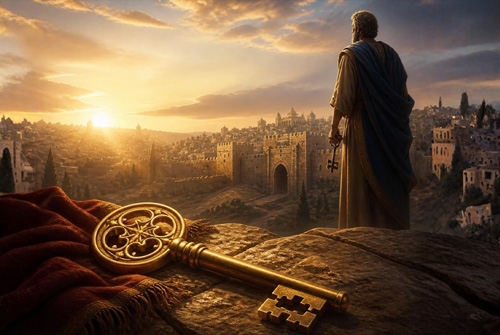
Our reading comes from a section of 1st Isaiah entitled: “Oracles Against the Pagan Nations” in which Isaiah prophesies against the surrounding nations that had oppressed Israel and Judah or had attempted to oppress them. But, in our first reading, it seems that Isaiah is taking a break from castigating and prophesying against those nations and has decided to pick on a particular individual named Shebna. In one of my Isaiah commentaries, Shebna is described as a Scribe who apparently had responsibility as the doorkeeper of the royal palace – sort of the “major domo” of the palace. But Shebna was part of a conspiracy that attempted to convince King Hezekiah to form an alliance with Egypt against the Assyrians. Isaiah, on the other hand, counseled Hezekiah to stand firm and rely on God: Make your alliance with God, not with Egypt! Because Shebna trusted in the Egyptians rather that in God, Isaiah prophesied that he would be shamed and removed from office and would be replaced by Eliakim who was more faithful to God. But here we may find the golden thread. Notice that Eliakim “shall be a father to the inhabitants of Jerusalem and to the house of Judah.” He will hold the key (a symbol of authority) to the House of David and “when he opens, no one shall shut, and when he shuts, no one will open.”
Contemporaries of Isaiah would have seen this prophecy as pointing to Eliakim who will be the guardian of the House of David. However, we should see this prophecy as pointing to Christ who existed before Eliakim but will come after him and will be the true guardian of the House; not only the houses of Israel and Judah but of all who believe in him as the Son of God. Christ will have the authority to bind and to loose.
Now, compare this to Jesus’ statement to Peter in our gospel this week: “I will give you the keys to the kingdom of heaven. Whatever you bind on earth shall be bound in heaven; whatever you loose on earth shall be loosed in heaven” and we see that Jesus conferred his authority (and the keys to the kingdom) on Peter and to the subsequent popes and the college of bishops united to the pope that followed Peter. Now, we should see that this prophecy of Isaiah concerns the church and the authority of the church to bind and loose. This is not to say that Protestants cannot be saved and cannot be absolved of their sins. The church believes that Protestants are united to our Catholic Church through their belief in Christ; they are just not in full communion with us. Ultimately, the forgiveness of sins belongs to God alone; but as Catholics, we believe that God has conferred that authority on the church in the sacraments of the church and particularly in the Sacrament of Reconciliation, when that sacrament is received with a pure and contrite heart.
Our second reading from St. Paul’s Letter to the Romans follows directly on the heels of last week’s second reading wherein Paul told the Gentile Christians of Rome that they were not to feel superior to the Jews who have rejected the Christian message, as that rejection is all part of God’s plan to bring the Gentiles to faith. In our second reading this week Paul extols the riches of the wisdom and knowledge of God; a wisdom that used the Jews to bring the Gentiles to faith! Review chapter 11 of Paul’s Letter to the Romans, particularly “God’s Irrevocable Call” in verses 25 – 36. And that “Irrevocable Call” refers to God’s covenantal relationship with Israel. They are the “Chosen People,” and Paul uses the analogy of an olive tree, (representing Israel), but through Irael’s disobedience, some of branches of that tree have been broken off, and branches from a wild tree (representing the Gentiles) have been grafted on. But the broken-off branches can be grafted back on again and the Jews will be saved in the same manner that the gentiles are saved; through Faith in Christ.
Our gospel passage from Matthew begins by reminding us that many of the people who encountered Jesus during his ministry believed him to be, at the very least, a great prophet. But Peter’s confession about Jesus’ true identity, and Jesus’ response to that confession, is the affirmation of the God-given authority of our church founded on the rock foundation of Peter and his successor Popes in union with the bishops. What the church binds on earth is bound in heaven; what it loosens on earth is loosened in heaven. Consequently, we who make the same confession concerning Jesus’ identity can firmly believe in the words of absolution we hear in the Sacrament of Reconciliation, and trust that what the church loosed on earth has truly been loosed in heaven.