Sixth Sunday of Easter, 2026
Reading 1: Acts 8:5-8, 14-17
Responsorial Psalm: Ps 66:1-3, 4-5, 6-7, 16, 20
Reading 2: 1 Pt 3:15-18
Gospel: Jn 14:15-21
As mentioned previously, during the Easter season our first reading from “Acts” is meant to draw our attention to the development of the early church in the first century. Our reading this week is from chapter 8 which directly follows the martyrdom of Stephen in chapter 7 which, in turn, set off the persecution of the church in Jerusalem, particularly by Saul who will eventually become known to us as St. Paul. Because of the persecution, many of the Christians left Jerusalem and took refuge in the countryside and in the neighboring area of Samaria.
Our reading this week shows the spread of the church into Samaria through the preaching of Philip and, apparently, through the miracles he performed there. The reading itself is quite straight-forward and requires little or no commentary other than to notice the “golden thread” that will connect it to our gospel. Upon hearing of the spread of the church to Samaria, Peter and John went to Samaria to pray over, and to lay hands on, the new-baptized Christians that they may receive the Holy Spirit.
We should probably notice here that the people of Samaria heard the preaching of Philip and accepted his message, even to the point of accepting baptism “in the name of the Lord Jesus.” But it took the apostles Peter and John to invoke the power of the Holy Spirit upon these newly baptized. If there is a message for us in this reading it is that the apostles, who are the first bishops of the church, have the power to invoke the Holy Spirit through prayer and the laying-on-of-hands. And that power to call down the Holy Spirit was passed on from the apostles to every bishop throughout the history of the church. And those bishops invoke that Holy Spirit on our priests at the time of their ordination to Holy Orders, by laying hands on them. That empowers our priests to do the same, and the most prominent example of this is at the Epiclesis, the prayer of consecration, in the Mass when our priest invokes the Holy Spirit to change the elements of bread and wine into the body and blood of our Lord. In other words, the authority of our priests comes directly from and is subject to, the authority of our bishops. In addition, every bishop becomes a bishop through “Episcopal Ordination” wherein other bishops pray over him and lay hands on him. As this process of Episcopal Ordination has been carried on throughout our church’s history, then we believe that the authority of every bishop could, theoretically, be traced back to one of the original apostles. This is what is referred to as “Apostolic Succession;” the continual line of succession of church authority from the original apostles to our present-day bishops. A bishop is understood to have the “fullness of the sacrament of Holy Orders,” responsible for teaching doctrine and governing the church in his jurisdiction.
In our second reading from 1st Peter, we are reminded that Christians have been, and probably always will be, persecuted for their faith, but we are never to succumb to that persecution. We are to be prepared always to defend our faith, but we are to do so with “gentleness and reverence,” never out of malice. In other words, be imitators of Christ. This reading reminds us that, as Christians, we are obligated to bear witness to our faith, even in the face of persecution. And we can bear that witness in many ways. Some will be called to preach, some to teach, and some will be called to martyrdom. But all of us are called to bear witness by the way we live our lives; by living according to the gospel values so that others may see that witness and be attracted to it and may fashion their lives accordingly. Bearing witness may be as simple as making the sign of the cross and saying grace in a restaurant. Do we always do so, or are we sometimes reluctant to draw attention to ourselves?
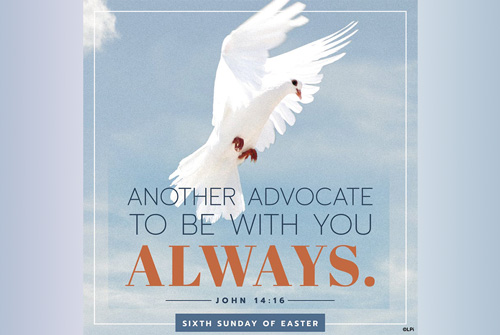
In our gospel passage from chapter 14 of John, Jesus promises that he will not leave us orphaned, and when he is no longer physically present in the world the Father will send ANOTHER advocate; “the spirit of truth.” Jesus is the FIRST advocate, to make intercession for us in heaven with the Father, and it is Jesus, as that first advocate, that will “ask the Father” to send another advocate. The Holy Spirit that he will send is the SECOND advocate who is a witness to Jesus on earth and a sign of Christ’s continued presence in the world and in the church. In addition, the Advocate it is the “spirit of truth,” and truth is unequivocal; something is either true or it is not true. Truth leads to knowledge of the Father and of Christ and that knowledge leads to freedom from sin and freedom from sin leads to eternal life with the Father and the Son. He also tells the apostles (and us) that the Spirit will cause them to realize that: “I am in my Father, and you are in me and I in you.” Jesus is “in the Father” by virtue of the divinity he shares with the Father; we are “in him” by virtue of the humanity we share with Jesus; and “he is in us” by virtue of the Eucharist we consume. That statement indicates the perfect union of God the Father with Jesus the Son, with the Holy Spirit, and with the church (us) that is permeated with the Spirit to lead us to truth. And that Holy Spirit is the golden thread that connects our readings this week.