Fourth Sunday of Easter
Reading 1: Acts 2:14a, 36-41
Responsorial Psalm: Ps 23: 1-3a, 3b4, 5, 6
Reading 2: 1 Pt 2:20b-25
Gospel: Jn 10:1-10
Our first reading this week from chapter 2 of “Acts” is a continuation of our first reading from last Sunday from “Peter’s Speech at Pentecost,” reflecting the mission of the early church in Jerusalem. In this passage, Peter addresses: “You who are Jews, indeed all of you staying in Jerusalem.” So, his message is addressed to everyone, Jew and Gentile alike, who hear his words of admonishment. But, in particular, he addresses the Jews who have asked: “What are we to do, my brothers?” Peter responds by admonishing them to repent and be baptized that they may receive forgiveness of their sins and the gift of the Holy Spirit. But notice, in verse 39, the promise of the forgiveness of sins and the gift of the Holy Spirit is made to the Jews, to their children: “And to all those who are far off, whomever the Lord our God will call.” Those who are far off are non-Jews, the Gentiles. So, we have an indication here that, at this very early point in the development of the church in Jerusalem, the message is delivered to all people, and there seems to be no separation between Jewish Christians and Gentile converts to Christianity. We know that hostility did eventually develop between Jews and Christians as time went on and even between Jews who accepted Christ and those who did not. But, at this point, the message seems to be delivered to anyone who will listen and “Those who accepted his message were baptized, and about three thousand persons were added that day”. We are told the community devoted themselves to meeting daily in the temple area and to the breaking of bread in their homes. This is the beginning of the Christian church.
The repentance that Peter is speaking of and St. Luke is recording for us in “Acts” is understood not simply as sorrow for sins committed in the past. It is a change of heart reflected in the manner in which one conducts his/her life after receiving and believing the message preached by Peter and the apostles after Pentecost. According to “Acts,” the Pentecost experience was the descent of the Holy Spirit upon Peter and the apostles in the upper room. Therefore, it is the Holy Spirit that emboldened the apostles and enabled Peter to speak out as he did in our first reading. Baptism is the expected response to that message by those who have accepted and believed the message. Baptism without belief is of no avail. Belief and confession of that belief is what brings salvation and baptism is the pledge of that belief. As about three thousand were baptized that day, the message preached by Peter through the power of the Holy Spirit was certainly effective.
Our second reading is from the 1st Letter of Peter and there is some disagreement among scholars as to whether the author is actually Peter the apostle. Regardless of authorship, the letter is addressed to Christian communities in Asia Minor, probably communities originally evangelized and founded by St. Paul, and are, therefore, primarily Gentile in nature. The suffering Peter refers to here is the suffering of Christians living in the diaspora (foreign lands) amongst people hostile to the Christian message. It seems the purpose of the letter is to encourage and inspire these communities to maintain the Christian way of life they have accepted in the midst of the pagan societies from which they withdrew in order to accept Christianity. The letter addresses many different facets of Christian life and our passage this Sunday addresses Christian slaves. It anticipates that Christian slaves are being mistreated for their way of life but: “If you are patient when you suffer for doing what is good, this is a grace before God.” Living a Christian life at this time (and just as much in our own time) is very difficult but we are reminded along with those to whom this letter is addressed that Christ suffered “for you,” and his suffering is an example for us to follow. Christ’s resurrection points to the future hope held in store for those who follow his teachings as presented to them by the apostles through the power of the Holy Spirit, particularly in times of persecution.
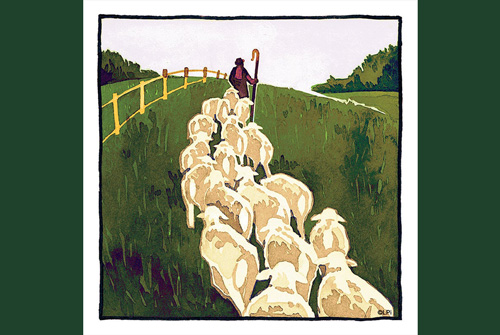
This passage from 1st Peter ends with a familiar reference to straying sheep and their shepherd. This motif certainly fits with our gospel passage from chapter 10 of the Gospel of John where Jesus refers to himself as a good shepherd who calls his sheep by name and they follow his voice. This is not simply a metaphor as it is certainly something the first-century people would have understood. Many of us in the modern world may be unfamiliar with the fact that the sheep actually do recognize and follow the voice of their own shepherd, not the voice of another shepherd. I have read where several groups of sheep from different flocks may graze together in one area but, when it is time to leave the area, each shepherd walks away calling his sheep and they follow only the voice of the proper shepherd.
This analogy by Jesus was certainly a condemnation of the Pharisees who wrote and enforced the laws of Judaism but refused to acknowledge Jesus and his teachings and were, therefore, shepherds the sheep would not follow. The laws they enacted were so restrictive, particularly those concerning the Sabbath and the prohibition of work on the Sabbath, that the people were unable to abide by all of them and were considered sinners for violating them. We have many examples of this in the gospels where Jesus was considered a criminal for performing a miracle on the Sabbath.
The point for our consideration is that the church should be seen as a sheepfold, the gateway to which is Christ. And that we, as the church, are the flock that listens for and follows the “Good Shepherd.” As we have accepted the teachings of Christ as presented to us by the Holy Spirit working through the church, then we are to listen for the voice of Christ in those teachings and follow them to the best of our ability.
We used to have “Blue Laws” in this country that required all businesses to be closed on Sunday to honor “The Lord’s Day.” That has obviously changed in the last few decades because far too many sheep are not listening to the voice of the shepherd.
We are all bound to fail occasionally in our attempts to listen to and follow the shepherd but, when we do, we have recourse to the sacraments of the church to bring us back to the flock and, hopefully, inspire us to listen more carefully to the voice of the Good Shepherd.