Easter 2026
Once again, I have chosen not to print out the readings for Easter as there are several and depending upon the Mass you attend this weekend, you will hear one of three different gospels. All of them, of course, deal with the Resurrection of Christ, but the three are quite different in the presentation. As there are so many readings, I will not try to comment on them; I’ll leave that to the homilist. But there are some points that maybe some are unfamiliar with and may be of interest.
One of three gospels will be proclaimed on Easter, depending upon the Mass you attend. Those gospels are: Jn 20: 1-9; Mt 28: 1-10 or Lk 24: 13-35.
If you take the time to read through these gospel passages you will notice that they differ substantially in the manner in which they present the Resurrection of Christ. It may be somewhat perplexing when reading the scriptures (in this case, the gospels) to find what seem to be contradictions, or stories about the same event that differ so greatly. But we have to remember that these gospels were written by different authors who were not collaborating with each other and were writing at different times; in some cases, many years apart. And those gospels, once written, were edited, and added to by others at a later date. In addition, the gospels were written many years after the events described. For example: If we attribute the Crucifixion, Resurrection and Ascension to approximately 33 A.D., then it is significant that the earliest gospel, that of Mark, was not written until about 68 A.D. (about 35 years later). The gospels of Matthew and Luke were not circulated until around 80 A.D. and the Gospel of John did not appear until close to the year 100 A.D.
Most importantly, none of these authors were eyewitnesses to the events described. The authors used material passed down to them, some oral and some written, over many years of time in compiling their gospels. That statement may be upsetting to some because we often like to attribute the Gospels of Matthew and John to the apostles by those names. But such is not the case and the introductions to those gospels in your bible will affirm that statement. In addition, each of these gospel authors was writing to a different audience and had to tailor that message to the audience.
For example: The Gospel of Mark is attributed to Mark, a cousin of Barnabas, who accompanied Barnabas and Paul on their first missionary journey but later became Peter’s interpreter in Rome. Mark was not a first-generation disciple and was not an eyewitness to the life of Christ. But, as Peter’s interpreter in Rome, Mark heard Peter’s first-hand account of the words and deeds of Jesus and that became the basis for his gospel. Mark was writing to severely persecuted Gentile Christians in Rome shortly after the crucifixion of Peter. There is a sense of urgency in Mark’s gospel because the situation for Christians in Rome at the time was urgent – severe persecution. As he was writing to Gentiles, Mark does not make use of Old Testament material in his gospel as the Gentiles would have little or no knowledge of the Old Testament. His message concentrates on the humanity of Jesus and on discipleship. If I were to paraphrase the message Mark was trying to convey to those persecuted Gentile Christians, it would be something like this: Jesus Christ was totally God and totally human, and in his humanity, he suffered greatly and was put to death, just like many of you are suffering and dying. But because of his total trust in God, God raised him from the dead and he is now enthroned in heaven. The same is available to you; do not lose your faith; do not apostatize.
We don’t know who the author of the Gospel of Matthew is, but the author was possibly a Jewish scribe who had a great deal of knowledge of the Old Testament and Jewish law and customs but was converted to Christianity. The framework of Matthew’s gospel is the Gospel of Mark (see the introduction of Matthew) and that is how we are pretty certain this gospel was not written by the Apostle Matthew – why would an eyewitness to the life of Christ (Matthew) use the account of a non-eyewitness (Mark) as the basis of his gospel? As Mark’s gospel was addressed to Gentile Christians, Matthew’s audience was the Jewish community, and his message was centered on convincing the Jews that this Jesus is the Messiah that was prophesied in their own scriptures.
Luke is mentioned in some of St. Paul’s letters as a disciple of Paul and tradition tells us he was a physician. As a disciple of Paul, Luke was not an eyewitness to the life of Christ. Luke was probably a non-Palestinian who is also the author of the Acts of the Apostles and, like Matthew, used the Gospel of Mark as the framework for his gospel. Luke’s audience was the predominantly non-Palestinian Gentile Christian communities established by St. Paul and his purpose in both his gospel and in Acts was not so much in giving new revelation to his audience but to affirm the reliability of the “Jesus story” that his readers were already familiar with through the preaching of the early Church, particularly of St. Paul. As Matthew and Luke borrow heavily from Mark, the three are said to “look alike” and are referred to as “Synoptic Gospels,” meaning they “look alike.”
Again, we don’t know who the author of the Gospel of John is but was probably disciples of the Apostle John which would likely make John the inspiration behind the gospel. The introduction to this gospel tells us that scholars believe it was composed by several writers over many years of time. This gospel is entirely different than the synoptics and is very literary and symbolic in nature. It does not follow Mark as a framework and does not present us with the same stories in the same order as do the other gospels. John’s gospel is the product of deep theological reflection on the teachings and actions of Jesus during his lifetime. It is much more concerned with giving us the meaning behind the words and deeds of Jesus than are the synoptics.
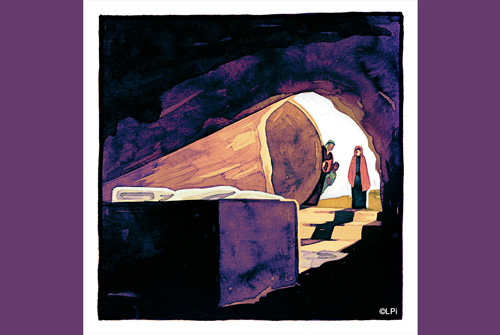
So, in the end, as Christians, it doesn’t matter to us which of these gospel accounts is closest to the actual facts of the Resurrection. What is important is that IT HAPPENED! It doesn’t matter whether Mary Magdala was alone when she discovered the empty tomb; whether she was accompanied by “the other Mary;” whether there was an earthquake and an angel; or whether the Resurrection was first experienced by two disciples on the way to Emmaus. The Resurrection is to be experienced by us, in our hearts and in our profession of faith in Jesus, and in the God that raised Him from the dead. The same is available to us; don’t lose faith, don’t apostatize!!!!