The readings for Palm Sunday are far too lengthy to copy into a reflection, and they are scriptures we are all familiar with. On Palm Sunday we first have a processional gospel of Jesus’ entry into Jerusalem from the Gospel of Matthew, readings from Isaiah and Philippians, and the Passion of Christ according to Matthew. There is far too much to try to comment on, but I’ll try to give you my “readers digest version.”
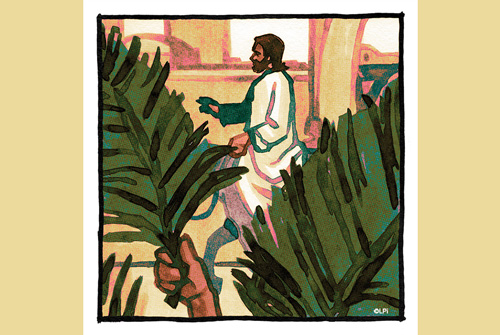
An interesting point about Jesus’ entry into Jerusalem in the synoptic gospels (Matthew, Mark and Luke) is that Jesus only enters Jerusalem once in these gospels, and it is on what traditionally refer to as Palm Sunday. The reason for this is that part of the theme of these gospels is what is referred to as “visitation and enthronement;” meaning that the emphasis of Jesus’ entry into Jerusalem is the visitation of his people (God is coming to His people) to redeem them, and to be enthroned as king; but not as king of Israel, as the king of the world; and that will be accomplished through the Crucifixion and the Resurrection.
The prophecy spoken of in Mt 21: 5: “Say to daughter Zion, behold, your king comes to you, meek and riding on an ass, and on a colt, the foal of a beast of burden,” is from Zechariah 9: 9 and is fulfilled in Jesus’ entry into Jerusalem.
In verse 9 of this gospel, the crowds cry out saying: “Hosanna to the Son of David.” The word “Hosanna,” in Hebrew is “a cry for help” and is generally understood to mean: “May God save us.” And in declaring Jesus to be the Son of David, they are declaring Jesus to be the descendent of David prophesied in 2 Sm 7 as that descendent who will rule Israel in peace and will take them out from under the oppression of the Romans. The crowds, and even the disciples, did not understand that Jesus will be crowned king, but not the political king they are looking for. His universal kingdom will be established through the Resurrection.
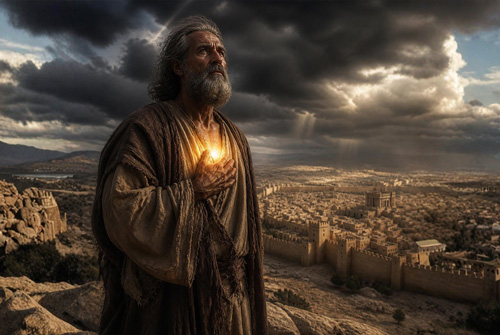
Our first reading is from chapter 50 of the Book of the Prophet Isaiah and is one of the four “Suffering Servant” oracles in that book. In our reading, the speaker is Isaiah; but we should see this as a prophecy of what Jesus will have to endure to accomplish his mission. “I gave my back to those who beat me, my cheeks to those who plucked my beard; my face I did not shield from buffets and spitting. But the Lord God is my help, therefore I am not disgraced.”
Our Responsorial Psalm reminds us of Jesus’ humanity. Knowing what he would endure for our salvation, his humanity cries out: “My God, why have you abandoned me?” If it is possible, take this cup away from me; but your will be done, not my will.
Our second reading from Philippians is an ancient Christian creed. It is centered on Christ and does not mention the Trinity as do our Apostles and Nicene creeds but focuses on the divinity of Christ and His humanity. He humbled himself and accepted death, even death on a cross; and because He offered himself for us, He was exalted to the right hand of God.
Our gospel passage is the Passion of Christ according to Matthew but also includes Matthew’s account of the Last Supper, which is the institution of the Eucharist, and Peter’s denial of Christ three times (how many times we have done the same?) There is too much to comment on here, so I urge you to read this account in Matthew 26 & 27 or listen attentively when it is proclaimed at Mass Sunday and put yourself in the crowd at that time. How could that crowd have gone from: “Hosanna to the Son of David” to “Let him be crucified” in a few days’ time? The answer to that question is simply that it was God’s will that Jesus pay the ultimate sacrifice for human sin. And why did Jesus have to die for our sins? That’s subject matter for another discussion at a later time.
Peace.