Fifth Sunday of Lent
Reading 1: Ez 37:12-14
Responsorial Psalm: Ps 130:1-2, 3-4, 5-6, 7-8
Reading 2: Rom 8:8-11
Gospel: Jn 11:1-45
Once again, there is a shorter version of this gospel that the presider may choose to proclaim at Mass, but I eliminated that version here in order to shorten this commentary.
I think it is clear that the “golden thread” that connects our readings this week is resurrection, but not necessarily the Catholic Doctrine of Resurrection. That doctrine refers to resurrection to eternal life for those who believe in Christ, are baptized to affirm that belief, and do their best to live their lives on earth according to the teachings of Christ.
Our reading from Ezekiel comes from chapter 37 entitled: “Vision of the Dry Bones,” and is a prediction of the restoration of Israel using the figure of resurrection as a symbol for that restoration. The restored Israel is understood here to be a restored and redeemed nation on earth, not a nation enjoying eternal life in the happy presence of God in heaven.
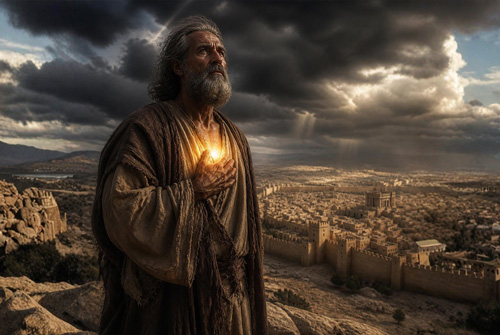
In this passage, Ezekiel is given a vision of a field covered by dry bones and is commanded by God to prophesy over the bones causing them to come together into human forms. Ezekiel does as commanded and the bones come together with skin and sinew, etc.; but there is no life in them. Then God commanded Ezekiel to prophesy to the Spirit to come and “breathe” life into the bodies. The Spirit of God (the Holy Spirit) is required to animate the bones, in the same way that God “breathed” his spirit into Adam’s nostrils in Genesis 2. Without the Holy Spirit there is no life. So, the “resurrection” of Israel in this prophecy is better described as the resuscitation of the dead nation of Israel through the Spirit of God being breathed into the nation causing the nation to choose to comply with their covenantal relationship with God. It is God’s merciful redemption of His Chosen People.
Our Responsorial Psalm reiterates this theme: “With the Lord there is mercy and fullness of redemption.”
St. Paul’s Letter to the Romans reminds us that: “The concern of the flesh is death, but the concern of the spirit is life and peace” (Rom 8:6), because the concern of the flesh is directed inwardly toward the self, and selfishness is directly contrary to the concern of the spirit, which is directed toward God. Therefore, if we do not have the spirit of Christ (the Holy Spirit) within us, we do not belong to Christ; but if we do possess the Holy Spirit: “the one who raised Christ from the dead will give life to your mortal bodies also, through his Spirit that dwells in you” (8:11). As with our reading from Ezekiel, without the Spirit, there is no life.
As mentioned in the past two commentaries, on the 3rd, 4th and 5th Sundays of Lent our gospel passages present us with three stories from the Gospel of John that were presented to the catechumens in the early church in preparation for their baptism at the Easter Vigil. The purpose of these gospel passages was to help the catechumens recognize potential obstacles to faith and the power of Jesus to overcome those obstacles. Those three passages are: The Samaritan Woman at the Well, The Man Born Blind, and the Raising of Lazarus. In the modern church, that tradition is carried on in the RCIA on those three Sundays in the “Scrutinies” for the same purpose as in the early church; but not simply for the catechumens. They are also meant to help us recognize obstacles to our own faith that we should be dealing with in this Lenten Season of “Purification and Enlightenment.”
Our gospel passage this week is one that we are all probably familiar with: “The Raising of Lazarus.” This is the last of the “signs” (the miracles of Jesus) in John’s Gospel and it is this miracle that directly leads to the decision of the Sanhedrin to condemn Jesus to death. This story is not found in the other gospels, although there are parallels in Mark and Luke. For example: the raising of Jairus’s daughter in chapter 5 of Mark and the raising of the widow’s son in chapter 7 of Luke.
There are many interesting statements in this passage and some of them are quite puzzling. In verse 4, Jesus clearly states that the death of Lazarus occurred so that the Son of Man may be glorified through it. Presumably, that glorification will come when Lazarus is restored to life so that those who witness it, and those who are told of it, will come to believe in Jesus as the Messiah. However, unfortunately not everyone who witnessed the event believed; see verse 46.
Here’s an important one: “Now Jesus loved Martha and her sister and Lazarus” (vs 5). If a person dies loving Jesus and being loved by Him, our Christian faith tells us that person will be welcomed into eternal life: “Inherit the kingdom prepared for you from the foundation of the world” (Mt 25:34). Why did Jesus weep before raising Lazarus? We don’t know for sure. Could it be that he felt the anguish of Martha and Mary and the others present who were truly saddened at the death of Lazarus? Could it be that He was saddened that so many would not come to belief even after the miracle of raising Lazarus from the dead? Or could it be that Jesus was saddened because He had to bring Lazarus back to life from what we call heaven – had to bring him back from eternal life — and restore him to earthly life simply to prove to the unbelieving Jews that He truly is the Messiah; knowing that Lazarus would have to undergo physical death again at some time in the future? As Lazarus would eventually experience death again, we should see that Lazarus was not resurrected, he was resuscitated. As one loved by Jesus, his resurrection will come at a later time.
Is death an obstacle to faith for some? Do we truly believe in the resurrection God promises us? Do we truly believe in what the scriptures and the church teach us, that if we have faith and we try to live by God’s commandments we will be resurrected to eternal life?
Verse 33 tells us: “He became perturbed and deeply troubled.” Again, we don’t really know why Jesus became perturbed. The footnotes tell us that He was possibly angry at the presence of death. Could it also be that he was perturbed because many would still not come to believe after Lazarus was raised to life? Could it be that Jesus was perturbed because he was about to bring Lazarus from the peace of eternal life to the chaos of the first century world? Could it also be that Jesus knew that, because of this miracle, the Sanhedrin would condemn him to death because Caiaphas, the High Priest, believed that it was better for one man to die instead of the people, so that the whole nation may not perish? (verse 50). Caiaphas was afraid that many of the people would come to believe in Jesus causing a division in the nation and civil unrest, giving the Romans an excuse to destroy the nation and drive the people into exile. That actually happened in 70 A.D. Unwittingly, Caiaphas prophesied that Jesus would die for the nation of Israel, “and not only for the nation, but also to gather into one the dispersed children of God” (all nations and all peoples; see verse 52).
Jesus prayed aloud in verse 42 so that the people would hear Him calling to God and would witness God answering that prayer in the raising of Lazarus, “that they may believe that you sent me.”
Jesus called out to Lazarus in a “loud voice” to come out of the tomb. Is this a reflection on Jn 5:28: “the hour is coming in which all who are in the tombs will hear his voice”?
When Lazarus came out of the tomb, he was bound hand and foot with burial cloths. Could that be a reflection on our own lives, bound hand and foot with sinful habits? But Jesus freed Lazarus and promises to free us as He said: “Untie him and let him go” (vs 44).
Notice also how this story of the resuscitation of Lazarus parallels the Resurrection of Jesus. There is a tomb, a stone to seal the tomb, there is a Mary, and there are burial cloths and a face cloth.
There is so much in scripture that calls us to not only read the scriptures, but to study them, to ponder them, and to prayerfully reflect on them to see the parallels in other parts of scripture and the parallels in our own lives as well. The wisdom of scripture is beyond compare, but we have to pay attention to it to see those parallels. There is a reason why the Bible is the number one best seller of all time!
Lent is a time to contemplate and pray about those obstacles to our own faith. It is a time of “Purification and Enlightenment;” a time to purify ourselves of our sinful habits through penance, and a time to come to a fuller understanding of our relationship to God through Christ and his church.