Fourth Sunday in Ordinary Time
Reading 1: Zep 2:3; 3:12-13
Responsorial Psalm: Ps 146:6-7, 8-9, 9-10
Reading 2: 1 Cor 1:26-31
Gospel: Mt 5:1-12a
The theme that connects our first reading from Zephaniah this week with our gospel from Matthew (and therefore, the golden thread) is the concept of humility.
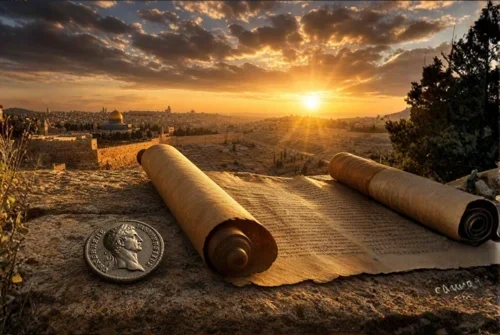
The opening verse in the Book of Zephaniah tells us that Zephaniah was active during the reign of Josiah, a king descended from David’s line who ruled in Judah between 640 and 609 B.C., a very important period in Israelite history. In the early part of Josiah’s reign, Israelite religion had fallen into several forms of idolatry; worshiping the sun, moon, stars, etc. Then a remarkable thing happened in the 18th year of Josiah’s reign (622 B.C.) when Josiah ordered repairs to be made to the temple in Jerusalem. During the renovations, the high priest, Hilkiah, found what he described as “the book of the law” in the temple. You can read about this discovery in 2nd Kings 22 and 2nd Chronicles 34. When you read these accounts, it appears that the Israelites did not know they had a written law, supposedly composed by Moses, and to be administered to the people by the Levitical priests. There has been plenty of research on this discovery by Hilkiah and it seems to confirm that the people were never aware of a written law and that what Hilkiah discovered was very probably not written by Moses. This is far too complicated to try to deal with in this short commentary but here are a few quotes from 2nd Kings that show us that the people were probably unaware of a written law:
“The anger of the Lord has been set furiously ablaze against us, because our fathers did not obey the stipulations of this book, nor fulfill our written obligations” (2 Kgs 22:13). Then Josiah ordered the destruction of all the pagan idols and altars, “and all the other horrors to be seen in the land of Judah and Jerusalem, so that we might carry out the stipulations of the law written in the book that the high priest Hilkiah had found in the temple of the Lord” (2 Kgs 23:24). Josiah then order that the Passover be celebrated as directed in the book of the law as: “No Passover such as this had been observed during the period when the Judges ruled Israel, or during the entire period of the kings of Israel and the kings of Judah, until the eighteenth year of King Josiah, when this Passover of the Lord was kept in Jerusalem” (2 Kgs 23:21-23).
The Judges were the first to rule the individual tribes after they entered The Promised Land and that would have probably been in the 12th century B.C. Kings did not rule the nation until the 11th century B.C. so we are talking many, many years between the time of the judges and kings and the discovery by Hilkiah in 622 B.C. If the Passover had not been observed during those years, then it is probable that the people and the kings were unaware of a law that required such an observance.
Zephaniah’s prophesy apparently comes from early in Josiah’s reign and is directed against false worship and against those who were in favor of an alliance with Assyria in order to protect Judah from the fate that befell Israel in 722 B.C. at the hands of the Assyrians. He would have certainly been in favor of Josiah’s reforms and the establishment of true worship as would have Jeremiah who would have been somewhat contemporary with Zephaniah. Unfortunately, Josiah was killed in battle in 609 B.C. and his reforms came to nothing and the old idolatry returned and eventually ended in the Babylonian Exile of 587 B.C.
Zephaniah’s message in our reading this week is humility before God and I’m sure it was chosen because it fits perfectly with our gospel this week from Matthew’s “Sermon on the Mount” beginning in chapter 5. But, if the people were unaware of the law and the humility it required of them before God, then humility before God was probably lacking in Judah as it had been in Israel. Israel paid for their lack of humility with the Assyrian conquest of 722 B.C. and Judah was destined to pay for that lack with the forthcoming Babylonian Exile.
Our second reading from 1st Corinthians carries on the theme of humility before God. Paul reminds us that Christians are not chosen because of their intellect or because of their noble birth, but because of faith. And if that is a true faith, it is a faith that comes from the conscious decision to humble ourselves before the God that we cannot see and to believe in what he teaches us through the Son that died to offer us the opportunity to dwell for all eternity in the happy presence of God.
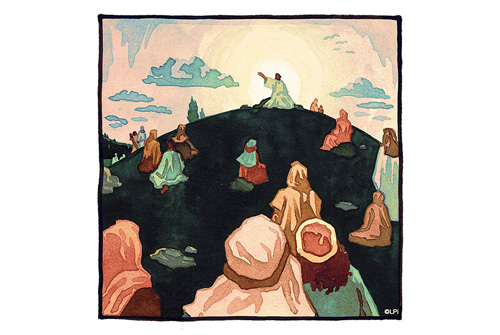
Not much needs to be said about the Sermon on the Mount as we are all pretty familiar with this gospel passage. But there are a few interesting points that some may not be familiar with. Our passage begins with Jesus going up the mountain: “and after he had sat down, his disciples came to him. He began to teach them,…” This verse would have meant more to the Jews who first read it than to most of us as a Rabbi always sat when he gave official teaching. Other translations of this verse say: “he opened his mouth and began to teach them.” When a Rabbi was said to have “opened his mouth,” the teaching became official, not a chance occurrence.
Then our gospel moves on to The Beatitudes, and notice how many of those refer to humility. The “poor in spirit” are those who are humble, not haughty. “Those who mourn” are those who mourn for the righteousness of moral conduct that leads to justification. The “meek,” the “merciful” and the “clean of heart” are all humble before God.
If we are not humble before God and teach others by our example to do the same, then the history we have in the bible should indicate to us that we are destined for the same fate as Israel and Judah. But that biblical history also tells us that God promised to restore his “chosen people” to their true homeland if they would reform their conduct and humble themselves. Through our baptism and our faith, we are also the “chosen people” and the same promise applies to us if we will humble ourselves before God. And that promise is eternal life in the happy presence of God.