Second Sunday in Ordinary Time
Reading 1: Is 49:3, 5-6
Responsorial Psalm: Ps 40:2, 4, 7-8, 8-9, 10
Reading 2: 1 Cor 1:1-3
Gospel: Jn 1:29-34
We are now entering the Liturgical Season of Ordinary Time. But “Ordinary” does not imply; “Ho-Hum, Ordinary.” In Ordinary Time, the “golden thread” that connects our first reading from the Old Testament to the gospel each Sunday will vary from week to week, whereas in an Extraordinary Season (Advent, Christmas, Lent or Easter), there is a theme that runs through the entire season. For example, in Advent the theme is anticipation in preparation for the coming of Christ at Christmas and his coming again at a time we cannot predict. In Lent, the theme is penance in preparation for Christ’s Passion, Resurrection and Ascension.
In the Book of Isaiah there are four passages that are identified as referring to the “Servant of the Lord” or as the “Suffering Servant” songs. If you care to review them, they are: Is 42:1-4, 49:1-7, 50:4-11 and 52:13-53:12. Our reading this week from Is:49 is the second of those four. Chapter 49 was probably written about the mid-6th century B.C.
Throughout the years there have been many interpretations as to who these passages are referring to and in reading them you will see why even Jewish scholars do not always agree on the identity of the “Suffering Servant.” For example, the servant is sometimes interpreted as the nation of Israel itself; God’s chosen people, who are to draw attention to the one true God. Others see the servant as the ideal Israel; the “Purified Remnant of Israel” that will emerge from the Babylonian Exile and, having suffered through their punishment in the exile, have been purified of their sins through that chastisement and are now prepared to lead the entire world to the God of Israel. Others identify the servant with the prophet himself (maybe Isaiah) and we have an example in our reading this week of two possible identities of the servant:
Notice how this passage begins: “The Lord said to me: You are my servant, Israel, through whom I show my glory.” That seems to identify the nation of Israel as the servant. However, the speaker seems to be an individual who declares: “The Lord said to me.” And tells us that the servant was formed by God “from the womb” for the purpose of bringing Israel back to God, which seems to indicate an individual (maybe Isaiah) who will be the instrument of God to lead Israel back to God. But notice toward the end of our reading that God says through the prophet: It is too little, says the Lord, for you to raise up the tribes of Jacob (Israel), “I will make you a light to the nations that my salvation may reach to the ends of the earth.” This would have been a radical statement for the people of ancient Israel to accept because they believed themselves to be the “Chosen People.” They would not have understood that God would reach out beyond the tribes of Israel to redeem the Gentiles as well. Therefore, to the Israelites, the “Suffering Servant” must be God’s chosen instrument (whether that instrument is an individual or the nation itself) to redeem Israel and restore it to the prominence it once enjoyed as the great kingdom under King David. We can see why there is confusion in attempting to identify the “Suffering Servant.”
Israel has certainly suffered greatly throughout its history. It has been brutalized by Assyria, Babylonia, the Persians, the Greeks, the Romans, Nazi Germany, and now by the Arab nations around them who want Israel to exist no longer. Consequently, it is easy to identify the servant as the nation of Israel; but it is also possible to see the servant as an individual and as an instrument of God. And that will be the “golden thread” of our readings this week.
Christianity, of course, has always interpreted these passages as referring to Christ. It is Christ who will bring Israel to the true worship of God when Israel recognizes Jesus as the Messiah they have longed for. It is also Christ who will lead all nations to the one true God. And it is Christ who suffered greatly and bore the sins of all (Jew and Gentile alike) in order to bring all to God. I suggest you read the last of the “Suffering Servant Songs” from chapters 52 and 53 listed above and compare that with what we know of the sufferings of Christ on our behalf. From that passage it is easy to see why Christianity has always interpreted the “Suffering Servant” as Jesus who will make God’s salvation “reach to the ends of the earth.”
The point of our first reading this week is that God is telling us through the prophet that God will raise up a servant; a servant who will suffer greatly and who will not only restore the tribes of Jacob (Israel) but will make God’s salvation “reach to the ends of the earth.” “Through his suffering, my servant shall justify many, and their guilt he shall bear.” “And he shall take away the sins of many, and win pardon for their offenses” (Is 53).
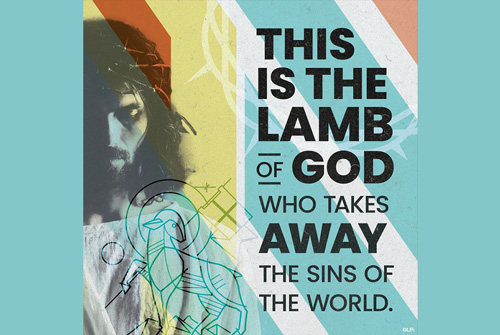
Now if we relate the above to our gospel passage, we see Jesus at the beginning of his public ministry and we see John the Baptist declaring: Here is your “Suffering Servant”; the one on whom I saw the Holy Spirit descend and remain. John is making Christ known to Israel and making it known that Jesus is the fulfillment of Isaiah’s “Suffering Servant” prophesies. He is declaring Jesus to be the Son of God who will “take away the sins of many and win pardon for their offenses.” The Suffering Servant is our “golden thread” this week who is prophesied by Isaiah and fulfilled in the person of Jesus.
But it is not only John’s responsibility to make Jesus known as the one who will take away the sins of the world; it is our responsibility as well. How are we pointing Jesus out to the rest of the world? How are we testifying to Jesus? Are we living the gospel values?