The Feast of the Baptism of the Lord
Reading 1: IS 42:1-4, 6-7
Responsorial Psalm: PS 29:1-2, 3-4, 3, 9-10
Reading 2: ACTS 10:34-38
Gospel: MT 3:13-17
This week we celebrate the Feast of the Baptism of the Lord, which is also the first Sunday in Ordinary Time. Consequently, we will be leaving the Extraordinary Liturgical Season of Christmas and entering Ordinary Time until we enter the Extraordinary Liturgical Season of Lent on Ash Wednesday.
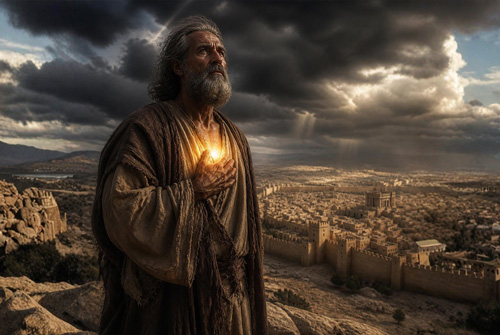
Our first reading comes from chapter 42 of the Book of the Prophet Isaiah and is the first of the four “Servant of the Lord” oracles in the Book of Isaiah. I know I have mentioned these in the past but if you care to look them up they are: 42:1-9; 49:1-7; 50:4-11; and 52:13 – 53:12. These oracles (also known as the Suffering Servant Songs) all point to one who will come into the world to establish peace and justice. The theme of our first Servant of the Lord oracle is Justice; God wants justice in our earthly relationships and justice cannot coexist with sinfulness. Sinfulness is injustice. So, we hear Isaiah proclaim of this Suffering Servant: “he shall bring forth justice to the nations….until he establishes justice on the earth.”
Many identifications have been proposed for the “Suffering Servant.” For example, the historical nation of Israel itself; or a purified remnant of historical Israel, or an ancient Old Testament prophet such as Elijah of whom it was believed he would return to earth to precede the expected Messiah; or the prophet Isaiah himself. Christianity, of course, sees these prophetic oracles as fulfilled in the life, death, resurrection and ascension of Jesus Christ. For that reason, the early church fathers often referred to the Book of Isaiah as the “Fifth Gospel.”
If we understand sin to be the ultimate injustice done to God, then if justice is to be established on earth, sin must be abolished. It is for that reason that the Suffering Servant came into the world: “he shall bring forth justice to the nations and establish justice on the earth.”
I know I have mentioned this in the past, but I will do it again as a reminder. Whenever we hear the term “The Nations” in the Old Testament it is a reference to Gentiles. In the Old Testament there are only two types of people; there are the Jews and then there is everyone else, and everyone else is a Gentile. So, this prophecy from Isaiah proclaims that justice will be established throughout the world, not just in Israel, but in the Gentile nations as well. Our second reading from the Acts of the Apostles also affirms that justice is intended for all nations: “In every nation whoever fears him and acts uprightly is acceptable to him.”
As Catholic Christians we understand that the Suffering Servant prophecy is fulfilled in the person of Jesus who came into the world to abolish the injustice of sinfulness, and he does so by establishing the church and the sacraments of the church through which sins are forgiven and the injustice done to God is absolved. We understand that baptism removes all stain of original sin. But, unfortunately, God bestowed on man the supernatural grace of reason, and with the grace of reason comes the gift of free-will; a gift that ideally should cause man to turn to God out of love; but it can also cause man to turn away from God in sin. As man is the only creation of God that possesses the gift of free-will, man is the only creation that can commit sin. In his great mercy, Jesus established the church and the sacraments of the church so that when our free-will directs us away from God we have recourse to the sacraments to turn us back again.
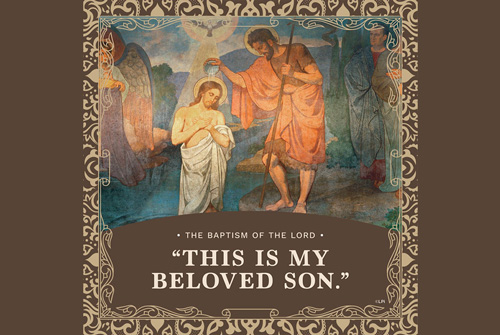
Our gospel this week is Matthew’s version of the Baptism of the Lord. As Jesus was sinless throughout his earthly life, one could ask the question: “Why was Jesus baptized?” Jesus himself answered the question stating that his baptism was: “to fulfill all righteousness.” Jesus’ baptism sanctified the waters of baptism and therefore established the Sacrament of Baptism for all of us. Through Jesus’ baptism, the waters of baptism received the power of a new creation in which the entire Trinity is present.
In the baptism of Jesus, we see the parallels of our own baptism. At Jesus’ baptism the Holy Spirit descended upon him in the form of a dove; at our baptism we are sealed with the Holy Spirit in the form of Sacred Chrism. At Jesus’ baptism God declared Jesus to be his beloved son in whom God was well-pleased; at our baptism we became the adopted sons and daughters of God. At Jesus’ baptism the heavens were opened; at our baptism the heavens are re-opened that were once closed by the sin of Adam. At Jesus’ baptism, Jesus prayed; after our baptism we must pray for the strength to avoid sin and to partake of the sacraments of the church when we do sin.
Christ was baptized not for himself, but for us. If he had not sanctified the waters of baptism for us, then our baptism would have been like that of John the Baptist. John’s baptism moved men to repent of their sins and to confess those sins, but John’s baptism was not sacramental. It took Jesus to give us the Sacrament of Baptism. The Sacrament of Baptism gives us the opportunity to re-enter the Garden of Eden, Paradise, Heaven, which ever term you prefer for that state of existence we all long for. Let us celebrate with joyful and grateful hearts as it is through that sacrament that the opportunity is presented to us.