Twentieth Sunday in Ordinary Time
Reading 1: Jer 38:4-6, 8-10
Responsorial Psalm: Ps 40:2, 3, 4, 18
Gospel: Lk 12:49-53
When considering the prophets of the Old Testament, there is an old saying that applies to them: “They bring comfort to the afflicted, and affliction to the comfortable.” We see the truth of that statement in our first reading. Jeremiah’s prophecy had so disturbed King Zedekiah and his princes that they threw Jeremiah into an empty well to die there.
It may be a toss-up as to whether Jonah or Jeremiah is the most unlikely of prophets. Jonah was simply a bigot who tried to hide from God rather than to accept God’s call to prophesy to the Gentiles, because he didn’t want the Gentiles to be saved. And when he finally accepted his call to prophesy and was successful, he was mad at God because he didn’t want to be successful in causing the Gentiles to repent.
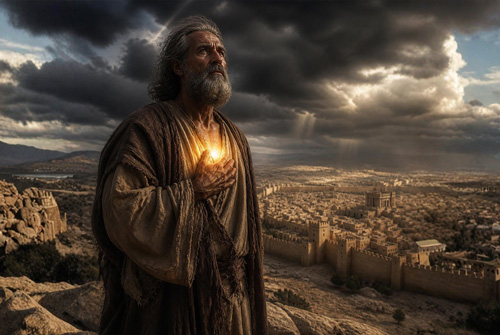
Jeremiah complained that he was too young to be a “prophet to the nations” and was not a good speaker. His lot as God’s prophet was loneliness, misery, reproach, persecution and imprisonment. In a moment of personal crisis Jeremiah essentially told God: I Quit! I will no longer prophesy on behalf of God. He regretted the day he was born wishing that “my mother would have been my grave” (Jer 20). Even though he tried to disregard his call to prophesy, he could not resist as the call “becomes like a fire burning in my heart” (Jer 20:9).
Jeremiah’s call to the prophetic office came at a crucial time in Israelite history; the late 7th and early 6th centuries B.C. This timeframe was just prior to and during the initial stages of the Babylonian exile which culminated in the destruction of Jerusalem and exiling of most of the survivors in 587 B.C At the time of our reading from chapter 38, the Babylonian siege of Jerusalem was well underway and the people were starving. Jeremiah’s role was to point out the futility of trying to resist Babylon, because God had determined to deliver Judah to the king of Babylon. God’s message delivered through Jeremiah was: If you resist Babylon, you will die here in the city; if you surrender you will prosper in the land of Babylon. Because of this message, Jeremiah was considered by many of the ruling class as a traitor and was imprisoned and, in our reading today, he was thrown into a well.
Jeremiah was so filled with the word of God that he could not resist his call to prophesy, even though that call resulted in great suffering. He afflicted the comfortable and paid dearly for that affliction, but he didn’t give up.
Our second reading from Hebrews reminds us that Jesus also afflicted the comfortable, and of the suffering he endured because of it on our behalf: “Consider how he endured such opposition from sinners, in order that you may not grow weary and lose heart.” Jesus never gave up either, even to the point of dying on the cross for preaching the Christian message.
So what’s the golden thread from Jeremiah 38 that connects it to our gospel? I’m not sure we can find a golden thread in this short reading but if we read more of the Book of Jeremiah I think we will begin to see the virtue of fortitude. In the face of all the persecution he endured, Jeremiah never stopped preaching God’s word, and most of what he spoke was bad news for those who heard him. Jeremiah was an iconoclast who exposed as hypocrisy the accepted religious and secular institutions of the time. He knew that religion could distort the will of God; could condone violence and hatred and substitute ceremony and idolatry for true worship. Jeremiah didn’t let up on anyone; priests, kings or citizens. He never quit. Jesus, too, was an iconoclast who exposed the religious institutions of the Pharisees and Sadducees as religion without substance. And Jesus, like Jeremiah, never gave up. Fortitude: the virtue of mental strength and courage to face danger and pain.
Our Gospel reading is a troubling one. We want to believe that Jesus came to bring peace and tranquility to the world, but that’s not what he tells us in this passage. He came to bring division and that division will be accomplished when he receives “the baptism, with which he must be baptized;” his Crucifixion and Resurrection. Division comes because Jesus’ message is radical, and his Resurrection is the most radical of all. Jesus brought affliction to the comfortable and that affliction will be in the form of division, a division that will occur between those who believe in the Resurrection and those who will not accept it. Division will occur between those who accept Jesus’ message and those who will not. And that will mean division within families.
Jewish law began as 10 simple commandments but, by the time of Jesus, the Scribes and Pharisees had expanded that to a multitude of laws regulating daily life. But Jesus said: it’s really pretty simple: love God and love each other; even if the other is a Gentile. Loving Gentiles was a thought completely foreign to the Jews of Jesus’ time because Gentiles were considered unclean and were not to be associated with. Being commanded to love Gentiles would bring affliction to the comfortable who thought they were obedient to God when they despised Gentiles.
We all know Jesus suffered terrible persecution, even to the point of crucifixion. But he never gave up; he kept on preaching his message even though he knew they would kill him for that message and there would be division on earth after his Resurrection. But he never quit. The division continues today, even after 2000 years. God did not promise us an easy life on earth; but he did promise an easy life in that state of existence we call heaven if we abide by that Christian message that brings comfort to some, but affliction to others. Do we have the fortitude to live our Christian values in this modern world?
Fortitude: the virtue of mental strength and courage to face danger and pain.
Reference: Artwork ©LPi