Sixteenth Sunday in Ordinary Time
Reading: 1 Gn 18:1-10a
Responsorial Psalm: Ps 15:2-3, 3-4, 5
Reading 2: Col 1:24-28
Gospel: Lk 10:38-42
Our first reading is an ancient one from the book of Genesis and probably dates to the 9th or 10th century B.C. The majority of the stories we read in the books of Genesis and Exodus come from oral traditions; stories that were passed on orally from one generation to the next over hundreds of years and were eventually written down and then edited by others and re-edited again and again until they are eventually included in our bible as we have them today. The purpose of this oral tradition was, of course, to pass on the history of the “Chosen People” to future generations. These stories were told by many different groups of people in different forms over many years of time and were eventually written down by essentially two different groups who had slightly different points of view. An author in the southern Kingdom of Judah presents God with very human characteristics (anthropomorphism). In addition, this southern author refers to God as “Yahweh” and this author’s history is referred to as the “Yahwist Tradition.” In our New American Bible, Yahweh is generally translated as “Lord,” so when God is referred to in our bible as “Lord,” and has human characteristics, there is a pretty good indication you are reading a Yahwist account.
In contrast, in similar stories written by an author from the northern Kingdom of Israel, God is presented as very transcendent, never acquiring human characteristics. In this northern tradition God interacts with humanity through angels or through dreams rather than face-to-face. And, in this tradition God is referred to as “Elohim,” and this author’s work is referred to as the “Elohist Tradition.” In our English language bibles Elohim translates as “God.” So, when God is referred to as “God” and interacts with humanity through angels or dreams, there’s a pretty good indication you are reading an Elohist account.
Our first reading comes from chapter 18 of Genesis and demonstrates a tradition of hospitality that has existed in the Middle East from the time of Abraham and continues today. That tradition of hospitality also defines the role of women in that society. Notice that Sarah stays in the tent and prepares the meal and is not seen in the presence of the visitors. Abraham visits with and listens to the visitors, but Sarah does not. That same theme will be carried on in our gospel this week as well.
If we went back and read chapter 17 and a little more of chapter 18 as well, we will get an account of God’s covenant with Abraham to make his descendants as numerous as the stars in the sky; and that Abraham and every male in his household and all his male descendants must receive the sign of circumcision so that “my covenant will be in your flesh as an everlasting pact.” When Abraham is told in chapter 17 that he will have a son, he laughs, because he is 99 years old and Sarah is 90. Nevertheless, Abraham obeyed God and circumcised every male in his household.
In our reading today, “the Lord” and two unidentified messengers (i.e., angels) appear to Abraham who, at first, thinks they are simply travelers, and he shows them great hospitality by serving them. But it is probably when one of the travelers (the Lord) asks “where is your wife, Sarah?” and says that within a year Sarah will bear a son that Abraham realizes who he is serving. If we read a little past the end of our reading today, we will see that Sarah overhears that she will bear a son and this time it is Sarah that laughs. The Lord hears her laugh and she denies doing so, but the Lord said: “Yes you did.” “Is there anything too marvelous for the Lord to do?” Notice that in this passage, God is referred to as “the Lord” and has human characteristics (he eats, he walks, he talks, etc.); a Yahwist account.
And, of course, the point of all of this discussion about the covenant and circumcision is that it leads to the birth of Isaac, the first born of the circumcised, covenanted “Chosen People of God.” Isaac is miraculously born to a man and woman well past their child-bearing years: “Is there anything too marvelous for the Lord to do?”
Our second reading from Colossians contains a curious passage that seems to cause confusion with some when St. Paul says: “in my flesh I am filling up what is lacking in the afflictions of Christ on behalf of his body, which is the church.” There is certainly nothing lacking in the sufferings of Christ on the cross on our behalf but we, the church, are the body of Christ. And the church (and we as its members) still suffer in this world and will continue to do so until Christ comes again and the church becomes the perfect “body of Christ;” we the body and Christ the head. It is the church that fills up what is lacking in the afflictions of Christ.
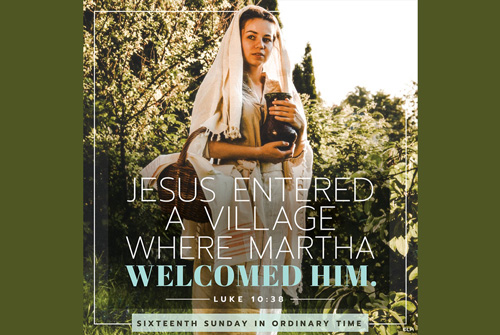
In our gospel passage we again see the theme of hospitality. Jesus visits the home of Mary and Martha in Bethany and is served by Martha. When Martha complains about having to do all the work herself while her sister, who tradition would say should be in the kitchen preparing the meal with her, sits at Jesus’ feet and participates in the conversation. Martha is told that Mary is doing the right thing by sitting at Jesus’ feet and listening to him. She is told that she is anxious and worried about too many things. Her hospitality is admirable and to be commended but it is apparently excessive and keeping her from being present to the Lord. This would be a shock to the people of Jesus’ time as it is counter-cultural – women are to prepare the meal and stay out of the way. But that’s the point! Luke is shocking his readers into realizing that old cultural traditions must give way to a new dispensation; sometimes traditions must be re-defined.
God created us to know Him and to love and serve Him. Doing so brings peace and happiness into our lives. Setting aside time each day to listen to God in quiet contemplation I think is the “golden thread” that connects our first reading to our gospel this week. Hospitality is also a thread that binds our readings together as Abraham served God “by the terebinth at Mamre” and listened when told he would have a son. Martha showed great hospitality to Jesus but was told that Mary had chosen the better part by listening. We are all called to serve God, but part of that service is to listen to and contemplate God’s word and his will in our lives. Doing so will keep us from being “anxious and worried about many things.”