Fifteenth Sunday in Ordinary Time, July 13th, 2025
READING 1: DT 30:10-14
RESPONSORIAL PSALM: Ps 69:14, 17, 30-31, 33-34, 36, 37
READING 2: COL 1:15-20
GOSPEL: LK 10:25-37
Our first reading comes from the Book of Deuteronomy and there is a fascinating history to that book. In the Jewish tradition, Deuteronomy is the last book of the Torah (Genesis, Exodus, Leviticus, Numbers and Deuteronomy) and Torah is a Hebrew word that means “teaching.” So, from the Jewish standpoint, the Torah is a statement of God’s laws, dictated by Moses, that they are to follow throughout their lives. The word “Deuteronomy” actually means “second law,” but is not to be understood as a new law or something over and above the law that Moses prescribed in Exodus, Leviticus and Numbers. In the Jewish tradition, it is understood as a re-presentation of the Law of Moses; a re-statement of what was prescribed in the earlier books of the Torah along with additional laws that were not found in the earlier books.
Christian scholars see Deuteronomy as the introduction to what is known as Deuteronomistic History (DH), and DH is the books of Joshua, Judges, 1 & 2 Samuel, and 1 & 2 Kings, which directly follow Deuteronomy in our bibles. Our Christian bibles consider these as historical books (telling the history of Israel) but the Jewish tradition calls these books “The Former Prophets” because of a Jewish belief that the writing of history was a prophetic endeavor.
Most scholars today accept DH as a literary unit, probably written by one person or possibly a small group of people and then edited by a few others, probably in the late 6th or early 5th centuries B.C. The purpose of DH was to record Israel’s history from the time they entered the Promised Land under Joshua until the end of the nation in the Babylonian Exile of 587 B.C. and to show how the sins of the people and kings of Israel led to the dissolution of the nation under the Babylonians. In other words, it was written to explain to the people why they had suffered so, and the reason for that suffering was their failure to follow God’s Law.
The Book of Deuteronomy was probably written after DH as a statement of what the author believed to be the laws that Moses gave the people, laws which they failed to follow resulting in the Babylonian Exile and most likely dates from the late 5th century B.C. So, Deuteronomy becomes an introduction to DH, or a statement of the law the Israelites failed to follow and brought to their attention in DH. We should see Deuteronomy as a statement of the Law which the people failed to follow, and the consequences of that failure are spelled out in the books of DH.
The opening verse of our first reading this week has Moses referring to the commandments and statutes in the “book of the law.” But he is also reminding the people that there will be a time in the future when they will fail to follow those commandments and he is imploring them to recognize that that time will come; but they are then to “return to the Lord your God with all your heart and all your soul.” So, the author (in words he implies to Moses) is already warning them that disaster awaits, but that they can always return to God and He will forgive their iniquity. That is probably a pretty clear indication that Deuteronomy was written after DH as the author is warning the people of something that had already taken place and was recorded in DH. And he also reminds the people that this law is not something remote or hard to follow. It is “already in your mouths and in your hearts; you have only to carry it out.” In other words, God’s law has been clearly revealed by God, so ignorance of the law is no excuse. We all know (Jews and Gentiles) that there is a power greater than ourselves that expects us to live in a certain way; and that way is to love God and love your neighbor.
The second option for our responsorial psalm this week also makes direct reference to God’s law with words like Law, Decree, Precepts, Command, Ordinances, and Words.
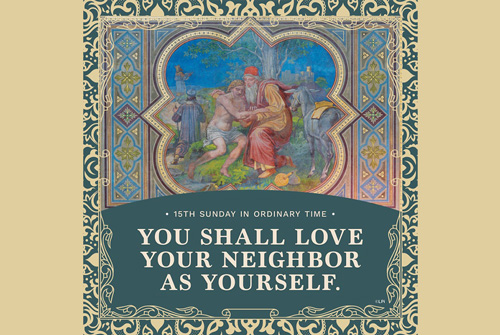
In our gospel reading from Luke Jesus also makes direct reference to the law when quizzed by a scholar of the law: “What is written in the law? How do you read it?” The scholar answers with what is known as the “Shema Prayer” (Dt 6:4) which is supposed to be recited by all faithful Jews every day: “The Lord is our God, the Lord alone! Therefore, you shall love the Lord, your God, with all your heart…” But then the scholar asks: “And who is my neighbor?” Moses commanded that you shall love your neighbor as yourself, but the question in the Jewish mind was: does that mean I have to love those hated gentiles as well? Who is my neighbor? Is it just my fellow Jews or does it include everyone? Jesus answers with a parable, in this case; the parable of the “Good Samaritan” and the point is well-made.
Jesus often teaches in parables because they reference something we are all familiar with, such as scattering seed on the ground, and compares that with the Kingdom of God. The seed must die, but in doing so it gives birth to an entire plant. In this case, the parable of the Good Samaritan is used to shock the scholar of the law into a radically new world-view. The Samaritans were considered to be half-breed Jews, the offspring of Jews who had intermarried with Gentiles and therefore, in the Jewish mind, they were the lowest of the low and Jewish law forbade Jews from intermingling with Gentiles or Samaritans. The priest and the Levite in the parable were obeying the law and passed by the victim because touching or aiding the victim or coming in contact with his bleeding wounds would have made them ritually unclean for temple worship. But the hated Samaritan came to his aid and treated him with mercy. “Go and do likewise.” The scholar of the law must now change is world-view by placing himself in the position of the victim. As the Jewish victim, would the scholar refuse the help of the hated Samaritan and simply allow himself to die along the road, or would he willingly accept the help? We, too, must change our world-view concerning those we may consider beneath us. Who is our neighbor?
In our second reading, St. Paul reminds us that all things were created by God in and through Christ. And all things have been reconciled to God by Christ through the blood of his cross; even the hated Samaritans and those in the modern world we may think of as Samaritans.
So where is the golden thread this week? We could make the case that the golden thread this week is God’s law, as the law is the subject of our first reading and is inferred in our gospel as it is a law which is already in our mouths and in our hearts and we have only to carry it out. We could also make a case for the golden thread being God’s mercy, as Moses reminded the people that there will be a time when they will turn back to God and be shown mercy; and Jesus reminds us to be a neighbor to everyone and to show mercy to others in need. We are “To go and do likewise.”