Solemnity of Saints Peter and Paul, Apostles
Reading I: Acts 12:1-11
Responsorial Psalm: Psalm 34:2-3, 4-5, 6-7, 8-9
Reading II: 2 Timothy 4:6-8, 17-18
Gospel: Matthew 16:13-19
This Sunday we celebrate the Solemnity of Saints Peter and Paul. As this celebration is specific for this date (June 29th), we don’t often celebrate it on Sunday, but this year we do. Saints Peter and Paul are considered the principal pillars of the church.
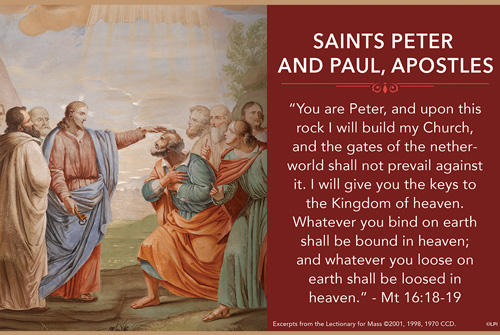
Peter, at this point in the narrative, is known by his given name, Simon and, we are told, he was the son of Jona and the brother of Andrew. It was Andrew who introduced Peter to Jesus. Upon this introduction, Jesus immediately gave Peter the symbolic name, Kephas, which is translated, Peter, meaning “rock” (Jn 1:42). In our gospel today we hear Peter’s confession that Jesus is the Messiah, and upon this confession Jesus confirms that he will build his church upon the rock foundation of Peter’s faith and that the powers of Hell will never prevail against the church. And in this passage, Jesus also confirms the primacy of Peter as our first Pope and in the primacy of his successors throughout 2000 years of history (Mt 16: 13-19).
The Holy Spirit inspired Peter’s very powerful Speech at Pentecost (Acts 2) confirming to all of Jerusalem that Jesus is the Son of God, raised from the dead, to bring forgiveness of sins to all who believe and will transform their lives. As a result of that speech, 3000 were baptized that very day and the church was born. The Pentecost event is so compelling because it points out to us the power of the Holy Spirit that could transform a group of uneducated fishermen into the greatest theologians the world has ever known and who formed the Christian church into an institution that has grown and thrived for over 2000 years.
Saints Peter and Paul come from entirely different backgrounds. Peter was a working man, a fisherman from the town of Bethsaida on Lake Galilee. Paul, originally known by his given name, Saul, was a Roman citizen born in Tarsus of Cilicia, a Roman province. He was trained as a tent maker and made his living as such. He was a Pharisee and well-educated in Mosaic Law and became zealous in defense of the Law against the Christian faith. He was present at the stoning of Saint Stephen, the first Christian martyr, and condoned the actions of the executioners.
The story of Paul’s conversion to Christianity is a compelling one found in chapter 9 of the Acts of the Apostles. In this account, Paul is transformed from being a hater of Christians intent on arresting them and bringing them before the Sanhedrin for judgment, to becoming a zealous preacher of the faith, even in the face of opposition, persecution and intense suffering. Paul never stopped preaching the faith becoming the church’s greatest missionary. We have fourteen letters of St. Paul in our scriptures attesting to the passion with which he preached the salvation to be found through Jesus Christ.
In the tumultuous times we live in, it is easy for us to lose faith in Jesus’ statement when we are surrounded by hatred, war, sinfulness and evil. But what choice do we have? We can believe in the teachings and words of Christ and try to live our lives in accordance with those teachings, looking forward to eternal happiness in the kingdom he promises us, or we can give up our faith in Christ, in which case every tick of the clock brings us one second closer to oblivion, with no hope.
The choice is before us: eternal happiness or oblivion. As Catholic Christians let us pray that God will grant us the missionary spirit of St. Paul and the apostolic zeal of St. Peter that we too may carry out Jesus’ commission to the apostles at his Ascension: “Go, therefore, and make disciples of all nations, baptizing them in the name of the Father, and of the Son, and of the Holy Spirit, teaching them to observe all that I have commanded you. And behold, I am with you always, until the end of the age” (Mt 28: 16-20).