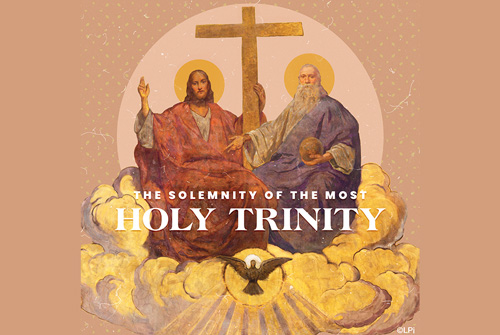
The Solemnity of the Most Holy Trinity
READING 1: PRV 8:22-31
RESPONSORIAL PSALM: PS 8:4-5, 6-7, 8-9
READING 2: ROM 5:1-5
ALLELUIA: CF. RV 1:8
GOSPEL: JN 16:12-15
This Sunday we celebrate the Solemnity of the Most Holy Trinity and our first reading from the Book of Proverbs celebrates the wisdom of God and begins with: “Thus says the wisdom of God.” Therefore, it is God’s wisdom that is speaking to us and tells us that it (wisdom) was the beginning of God’s ways. This “wisdom” was present in the beginning; before the earth, the depths, springs of water, the mountains, before any of creation existed. And, we are told, this “wisdom” was God’s craftsman and God’s delight day by day. And as this “wisdom” was with God in the beginning, we have a foreshadowing of the plurality of divine beings; Father, Son and Holy Spirit. Something was with God in the beginning and was not a creation of God but was, in fact, the instrument (craftsman) through which all of creation came into being. So, the message we take from this is that all of creation came into existence through the wisdom of God, which was with God in the beginning and is the author of all of creation.
If we read this passage from Proverbs in light of another passage; that being the beginning of the Gospel of John, we get another insight. In John’s gospel we are told: “In the beginning was the Word, and the Word was with God, and the Word was God. All things came to be through him (the Word), and without him nothing came to be.” The Gospel of John was originally written in Greek and the Greek word we translate here as “Word” was, in the original Greek, “Logos.” And in Greek, Logos has the connotation of wisdom, or the manifestation of wisdom; the rationality of God through which all things came into being. In other words, that which created everything was the wisdom or rationality of God because everything in creation has a reason and a purpose for its creation. And then John tells us: “And the word (wisdom, Logos, rationality of God) became flesh and made his dwelling among us.”
Putting these two passages together we begin to see that the Wisdom of God is the Word of God, and the Word of God is Christ who existed with God from the beginning and that it is through Christ that all things came to be and that it is through Christ that all things have a reason and a purpose for their existence. We can clearly see the reason and purpose in all of creation where everything is supposed to work in harmony with everything else in creation. All animal life requires oxygen for existence, but it expels a poisonous gas called carbon dioxide. But plant life assimilates that carbon dioxide and produces oxygen for animal life. Everything has a purpose and the purpose for humanity is to love and honor God and to abide by his commandments. And what sets humanity apart from the remainder of creation? Humanity possesses “reason,” the very thing that God used in creating the universe. We are created in the image and likeness of God and that which makes us the image and likeness of God is reason; the ability to make choices that are in conformity with the mind of God. But reason also involves free-will and it is free-will that allows humanity to make choices contrary to God’s will. Because we possess reason, we participate in the mind of God. But because we possess free-will, we can deny that participation.
The Book of Proverbs is thought to be a collection of ancient writings that was probably edited into the book as we have it today in the 5th century B.C. and it gives us a little insight into the Holy Trinity. We haven’t heard about the Holy Spirit yet, but we will. I just find it fascinating to think that something written five hundred years before the time of Christ could be hinting about the Holy Trinity. I guess that’s what we mean by divine inspiration.
Our second reading comes from St. Paul’s Letter to the Romans and Paul tells us that through faith, we have been justified by God and are at peace with God through Jesus Christ. And the faith that justifies us comes to us through the Holy Spirit (told you we would hear about the Holy Spirit). The faith that comes to us through the Spirit gives us hope, and hope gives us the strength to deal with our afflictions, many of which are caused by our own poor free-will choices. Hope is belief in that which we cannot see; and that which we cannot yet see is eternal happiness with God in heaven. But through faith, which comes to us through the Holy Spirit, we have hope, causing us to constantly strive to use our reason and free-will in conformity with our participation in the mind of God.
Our gospel reading is from chapter 16 of the Gospel of John and in this passage, Jesus tells his disciples that there is much more for them to learn, but when the Holy Spirit comes upon them, they will be led into all truth. And that truth comes from God because Jesus tells us: “Everything the Father has is mine; for this reason I told you that he (the Spirit) will take from me what is mine and declare it to you.” As those disciples will become apostles when the Spirit descends upon them, they become the first bishops of the church, and it is through the church and the Holy Spirit we receive through participation in the church that “all truth” is given to us if we will accept it.