A Reflection on the Readings for Pentecost Sunday,
June 8, 2025
Reading 1: Acts 2:1-11
Responsorial Psalm: Ps 104:1, 24, 29-30, 31, 34
Reading 2: 1 Cor 12:3b-7, 12-13
Gospel: Jn 20:19-23
This Sunday, we celebrate the Feast of Pentecost, which marks the 50th day after Easter and commemorates the descent of the Holy Spirit on the apostles and those gathered with them in the upper room in Jerusalem, as indicated in our first reading from the Acts of the Apostles.
The word “Pentecost” comes from the Greek “pentecoste” which literally means “50th day.” But notice that our first reading from Acts begins with: “When the time for Pentecost was fulfilled…” indicating that Pentecost was also a Jewish festival at the time called “Shavuot,” celebrating the first fruits of the wheat harvest and, later, a remembrance of the Law given by God to Moses on Mt. Sinai. The early church adapted the Jewish feast of Shavuot to the Christian feast of Pentecost, understanding that the coming of the Holy Spirit into the world was the “first fruits” of a new dispensation that fulfilled and surpassed the old dispensation of the Law. The day of Pentecost and the coming of the Spirit marks the beginning of the church’s mission to spread the gospel throughout the world, as the church is enabled to do through the power of the Holy Spirit.
Our readings this week present two different accounts of how the apostles received the Spirit: one through “tongues as of fire” and another through Jesus breathing the Spirit upon them. We often find various descriptions of the same event in scripture, and we must remember that what we read was written by different authors at different times, often separated by many years. So, it is not for us to ask: Which way did it actually happen? The important point for us to grasp through faith is that it actually did happen, not how it happened. And we can do so more readily by seeing the effect of the event. In other words, we should ask: If the Pentecost event did not happen, then how could the Christian faith have spread from a group of frightened and confused apostles in Jerusalem and become the worldwide institution that it is today? The fact that the church did spread throughout the world should be indication enough for us that the Pentecost event is a historical reality.
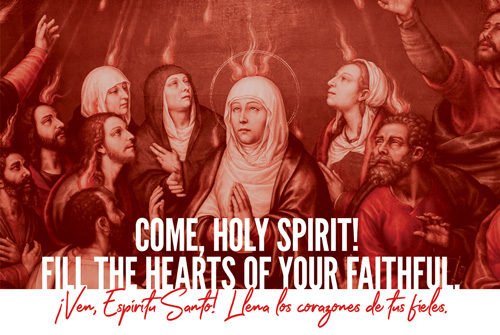
Our first reading tells us that: “Suddenly there came from the sky a noise like a strong driving wind… and tongues as of fire,” which rested on the apostles. Wind, in scripture, often signifies the presence of the Spirit (see John 3:8) as the wind blows, but we do not know where it comes from or where it is going. Fire often represents the presence of God (see Ex 19:18) as God presented himself to the people in fire. We are also told that the apostles began to speak in different tongues. Here, speaking in tongues seems to refer to speaking in different languages as the Spirit enabled them to proclaim. Today, we often associate “tongues” with unintelligible utterings of the Holy Spirit. Could it be that what the apostles proclaimed was unintelligible except to those who were open to the Spirit? Or could it be that all these Jews “from every nation under heaven” who had lost their native language of Hebrew and now spoke the languages of the nations in which they lived, suddenly, through the power of the Spirit, understood the apostles in their native language of Hebrew? That is just speculation on my part, but it is something I have often wondered about. Regardless of my speculation, it was the Holy Spirit that enabled the proclamation to be understood and believed by those who heard that proclamation.
Scripture also often represents the Spirit as “living water” (see John 4:10-11 & 8:37-38). All life is dependent upon water, which comes upon us as rain. The water itself remains unchanged, but it manifests itself in every living organism in different ways; plants grow and thrive in ways that differ from those of animals. The same is true of the Holy Spirit. The Spirit itself never changes, but it manifests itself differently in each individual who receives the Spirit.
In our second reading from 1st Corinthians, St. Paul reminds us that there are different kinds of spiritual gifts and different forms of service, but they are all inspired by the one unchangeable Spirit. “To each individual, the manifestation of the Spirit is given for some benefit,” for we are all baptized in one Spirit into one body, the church, and the head of the church is Christ. We each receive the Spirit for some benefit; some will speak in tongues, some will interpret tongues, some will teach, some will interpret scripture, and others will serve in various ways.
And, as our gospel passage from St. John indicates, some are called priests and bishops to carry on what the apostles began on Pentecost. Jesus “breathed” the Holy Spirit on the apostles and commissioned them: “As the Father has sent me, so I send you” to go forth and proclaim the gospel to all nations. This is the beginning of the priesthood and the church’s mission to spread the gospel throughout the world, as the church is enabled to do so through the power of the Holy Spirit. The apostles, whom Jesus “breathed” upon, were the first bishops of the church, and the authority they received through the Holy Spirit has been passed on, through 2000 years of history, to their successors, the present bishops of the church. That is “Apostolic Succession,” and it assures that our bishops have received their teaching authority through Apostolic Succession from the apostles.
St. Basil the Great, bishop, expressed the power of the Holy Spirit in our lives in words that are worth remembering: “Through the Spirit we become citizens of heaven, we are admitted to the company of the angels, we enter eternal happiness, and abide in God. Through the Spirit we acquire a likeness to God; indeed, we attain what is beyond our most sublime aspirations – we become God” (Liturgy of the Hours, volume II, page 976).
Pray for vocations to the priesthood and religious life and pray that we may each come to recognize the benefit for which we have received the Holy Spirit.
Art: ©LPi