A Reflection on the Readings for the Fourth Sunday of Easter, May 11, 2025
Reading 1: Acts 13:14, 43-52
Responsorial Psalm: Ps 100:1-2, 3, 5
Reading 2: Rev 7:9, 14b-17
Gospel: Jn 10:27-30
This week, we celebrate the 4th Sunday of Easter, a Sunday that is also known as “Good Shepherd Sunday,” which becomes evident in our gospel passage. But the Easter season is also a time when we celebrate the development of the church in the first century, and that theme is made apparent in our first reading from Acts.
Chapter 13 of Acts describes the first missionary journey of Paul and Barnabas to Antioch. The purpose of these missionary journeys was to spread the gospel message and develop Christian communities outside of Jerusalem. Paul and Barnabas always attempted to convert the Jews first in the communities they visited, as we see in our first reading, where Paul addressed the congregation in the synagogue at Antioch. When the Jews rejected his message, Paul turned to the Gentiles who “glorified the word of the Lord… and the word of the Lord continued to spread through the whole region.” As the word spread throughout the region, the church grew and developed.
It seems strange that Paul and Barnabas (both Jews) would be rejected by the Jewish communities when they preached that the Messiah the Jews had been longing for and waiting for and was prophesied in their scriptures had come in the person of Jesus. Why did the Jews reject, and the Gentiles accept the message?
If we turn to St. Paul’s Letter to the Romans, in chapter 11, we will find Paul’s answer to that question in verses 25 to 36 under the heading: “God’s Irrevocable Call.” Paraphrasing those verses, Paul tells us that God intentionally hardened the hearts of the Jews to the gospel so that Gentiles would come to faith. Presumably, this references the historic animosity between Jews and Gentiles at the time. If the Jews accepted Christ, the Gentiles would consider Christianity to be a Jewish thing and would reject it. But, if the Jews rejected the gospel, the Gentiles may accept it.
This is not unprecedented, as God also hardened the heart of Pharaoh against Moses’ exhortations to “let my people go” so that God would be made manifest through the ten plagues he imposed on the Egyptians and through the Exodus event. But the Jews are the “Chosen People,” how could God exclude them from salvation through Christ? According to Paul, when the “full number” of Gentiles comes to faith, all Israel will be saved. Addressing the Gentiles in the Letter to the Romans, Paul says: “In respect to the gospel, they are enemies on your account; but in respect to election, they are beloved because of the patriarchs. For the gifts and the call of God are irrevocable.” In other words, God’s covenant with Abraham, Isaac, and Jacob is irrevocable; the Jews are the “Chosen People,” and God will not abandon them. Paul quotes Isaiah 59:20-21 in assuring his readers that the Jews will ultimately be saved in the same manner as the Gentiles. Israel’s deliverer “will come out of Zion,” meaning the Messiah will be a Jew, who will “turn away godlessness from Jacob… when I take away their sins.” The Jews will be saved in the same manner as the Gentiles, through belief in Christ and the forgiveness of their sins.
Our first reading points to the development of the church in the 1st century primarily through the preaching of St. Paul to Gentile communities. Here, we are given an idea of what the church might have looked like if we had lived in the 1st century. But in our second reading from the Book of Revelation, we are given a heavenly view of what the church is intended to be. God intends for the church to be “a great multitude… from every nation… that stands before the throne and before the Lamb.” In the Book of Revelation, this great multitude is composed of those who have been martyred in the fierce persecution by the Romans or have survived that persecution and maintained their faith. Trials, tribulations, persecution, and, unfortunately, even scandals are expected in the church on earth. Still, we, too, can stand before the Lamb on the throne if we maintain our faith throughout the trials. When we finally stand before the Lamb in that existence we call heaven, there will no longer be a need for the church, for we will see “The Lamb who is in the center of the throne” face to face, and the Lamb will shepherd his people.
But until we stand before the Lamb, the church is an earthly institution that requires shepherding.
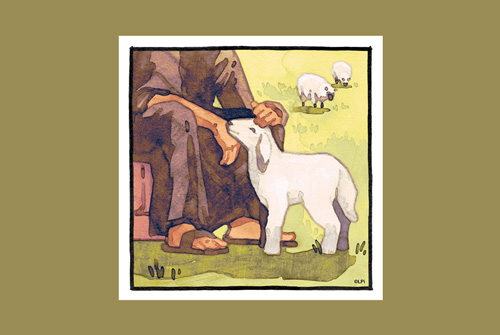
Our gospel makes it clear that Jesus is the Good Shepherd of the church. Our priests, bishops, cardinals, and popes are the earthly leaders of the church, but they are human and not infallible, as has been made abundantly clear in the church’s ancient and recent history. However, the true shepherd of the church is infallible and has said that the gates of hell will not prevail against it. No matter the sins of our earthly leaders, Christ has promised that the church will prevail, and that is the source of our hope for finding ourselves standing before the Lamb in the center of the throne because the church is the Sacrament of Salvation! The Lamb in the center of the throne is the Good Shepherd, and the Lamb is in a relationship with the Father; “The Father and I are one.” By hearing and following the voice of our Good Shepherd, he invites us into that unique relationship where we can never be separated from the Shepherd or the Father. “No one can take them out of my hand.”
Graphic: ©LPi