A Reflection on the Readings for the Third Sunday of Easter, May 4, 2025
Reading 1: Acts 5:27-32, 40b-41
Responsorial Psalm: Ps 30:2, 4, 5-6, 11-12, 13
Reading 2: Rev 5:11-14
Gospel: Jn 21:1-19
In the season of Easter, we celebrate the development of the church and, specifically, the early Christian community of the first century. There is no doubt that the early church would not have developed amid the hostility of the Jewish hierarchy toward the preaching of the apostles without the power of the Holy Spirit. Filled with the Holy Spirit, the apostles spoke out without fear, inspiring many others to be baptized, and to receive the Holy Spirit, and become a part of that early community. The Resurrection of Christ is the most important historical event in human history for which we, as Christians, are eternally grateful. But, in recognizing the development of the early church initiated by the Resurrection, we should always be aware of the role of the Holy Spirit throughout the church’s history.
We should also be aware of the role of the power of the Holy Spirit in the individual Christian, not only in the early church but in the church we inherited 2000 years later. Christians are called upon to be witnesses of the gospel in our words and in our deeds as exemplified by the apostles. That Christian witness is the theme of our first reading this week from the Acts of the Apostles wherein the apostles are brought before the Sanhedrin for the second time. If we read the entire chapter, we will see the apostles had been ordered to stop preaching Jesus as the Messiah, and the Sanhedrin intended to put them to death because they continued to preach. Peter’s response to the demands of the high priest was: “We must obey God rather than men.” In the face of persecution and death, the apostles held fast to their faith through the power of the Holy Spirit because they knew that even their death would not silence the gospel message. And because that message was so powerful in the words and deeds of the apostles, the church continued to grow day after day.
The Sanhedrin relented in putting the men to death because of Gamaliel, a teacher of the law who cautioned them against doing so. It seems ironic that Peter and the apostles would not stop preaching because they obeyed God’s word and offered it to the Sanhedrin. Still, the Sanhedrin rejected God’s word and accepted man’s word from Gamaliel.
It is often said that our Holy Mass is a time when heaven touches the earth, and earth touches heaven. In our second reading from the Book of Revelation, John’s vision is of that heavenly worship: the church in heaven. When we participate in the Mass, we are participating in that heavenly worship as described by John. Notice how John’s vision includes “every creature, in heaven and on earth,” worshiping God. We should recognize that we are not separate from that heavenly worship; we are participants in it along with all the saints who have gone before us. And, as we are participants in that worship, we are in a “Common Union” (Communion) with all the saints. There is one church that exists in both heaven and on earth, and it is the church we celebrate during the Easter season.
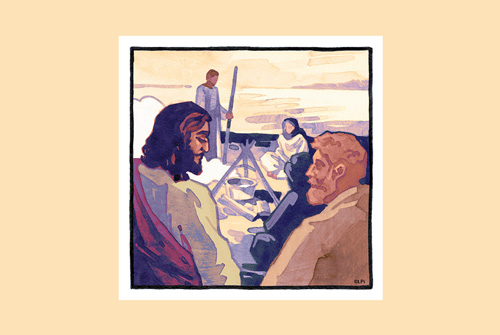
Our gospel is from the final chapter of the Gospel of John and presents us with another appearance of post-Resurrection to the disciples. Notice that there are only seven disciples mentioned in this passage. We are not given an explanation as to why, but the number seven may be symbolic here as the number seven was considered the perfect number in Hebrew tradition. So, seven disciples may symbolically represent the “fullness” of the community of the disciples, regardless of the actual number of disciples.
Another interesting point in this passage is that the disciples fished all night and caught nothing until Jesus directed their efforts to the “right side of the boat.” Yet, when they came ashore with their net full of fish, but before they had emptied the net, there was a charcoal fire with fish and bread baking on the fire. This meal presented to the disciples has Eucharistic significance as verse 13 recalls the Multiplication of the Loaves in chapter 6 of John and Jesus’ actions at the Last Supper: “Jesus came over and took the bread and gave it to them, and in like manner the fish.”
Why 153 fish in the net? We are not given an explanation in the scriptures, but there are plenty of theories. One theory is that, at the time, it was believed there were 153 nations in the known world. Another is that it was believed there were 153 varieties of fish in the sea. The net encompassed all 153, symbolizing the universal mission of the church; everything is encompassed in that mission. Another interesting theory is that before John Paul II added the Mysteries of Light to the Rosary, there were 15 decades of Joyful, Sorrowful, and Glorious mysteries, equaling 150 “Hail Marys” plus three introductory in the Rosary = 153.
Our gospel passage ends with Peter’s rehabilitation by confessing his love for Jesus three times to counteract the three times he denied Jesus. But this also emphasizes Peter’s role in the church as the Vicar of Christ on earth, the head of the earthly church, as he is commanded three times to feed and tend Jesus’ sheep. Peter will represent Christ’s presence on earth, but in doing so, he will also follow Christ in his death by crucifixion. “Someone else will dress you and lead you where you do not want to go.” Peter’s role and the role of the church that we celebrate this Easter season is: “Follow me.”
Artwork reference: ©LPi