A Reflection on the Readings for the Fifth Sunday of Lent, April 6, 2025
Reading 1: Is 43:16-21
Responsorial Psalm: Ps 126:1-2, 2-3, 4-5, 6.
Reading 2: Phil 3:8-14
Gospel: Jn 8:1-11
Just as the season of Lent should remind us of our need to do penance and to seek God’s forgiveness for our transgressions, it should also remind us of God’s mercy in granting us that forgiveness. God’s mercy is the theme of our readings this week.
Our first reading this week from chapter 43 of the Book of Isaiah is from a portion of that book referred to as 2nd Isaiah (chapters 40 to 55). It is referred to as such because this portion was not authored by the prophet Isaiah himself but by an unknown author who wrote many years after Isaiah but was inspired by the tradition of Isaiah to carry on his work. Isaiah the prophet was active in the late 8th century B.C., but 2nd Isaiah is from the early to mid-6th century, toward the end of the Babylonian exile.
Chapter 43 is entitled “Promises of Redemption and Restoration.” If we read the entire chapter, we will see that it is a prophecy promising the end of the exile. But it is also a prophecy that reminds the reader that God alone is their creator, protector and redeemer. God alone created Israel “for my glory” (43:7) and redeemed Israel from Egypt so that all nations may see God’s glory; God will redeem them once again from the Babylonian Exile for his glory. But this chapter also reminds the reader that no one could have predicted the things that God has accomplished in the past: “Who among them could have revealed this, or foretold to us the earlier things?” (43:9). It is God alone can know and predict future events.
In the first portion of chapter 43, the reader is reminded of all that God has done in the past, but in the portion that we will hear proclaimed this week, God said through the prophet that the people are not to dwell on the miracles of the past: “Remember not the events of the past” because something new and greater is about to happen: “See, I am doing something new” (43:18-19). As marvelous as the wonders of the Exodus from Egypt were in the past, so too will be the future wonders of the Exodus from Babylon. That “something new” is deliverance from Babylon so that the people “might announce my praise” (43:21). Deliverance from Babylon is not because the Israelites have “earned” that deliverance: “You did not call upon me, O Jacob, for you grew weary of me, O Israel.” It is God’s mercy alone that brings deliverance so that the people may announce God’s praise and the nations (Gentiles) may come to know God.
“Something new” to the Israelites of the 6th century would have meant deliverance from Babylon and restoration to their homeland. But the story never ends with the Old Testament; it must be carried forward into the New Testament. “Something new” in the New Testament is initiated by the Incarnation, through which deliverance is not from Babylon but from eternal separation from God through sin, and restoration to the homeland we call heaven. Think of the early chapters of the Book of Genesis that describe how we were created to co-exist in the presence of God without the anxieties we experience in our daily lives. But, because of sin, we were banned from that existence in Eden (paradise, heaven, etc.). Because of sin, we are eternally separated from God until God, in his mercy, initiates “something new” in the Incarnation, Passion, and Resurrection of Christ. Christ arose from the dead and ascended into Eden, showing us that the same is available to us through God’s mercy if we seek that mercy with pure and contrite hearts. God, in his mercy, offers us redemption and restoration so that, through gratitude, we may announce his praise, and the nations may come to know God.
This reading from Isaiah should remind us that the Old and New Testaments are not separate books of scripture; they fit together like a hand in a glove. The Old leads us to the New; “What is revealed in the New is hidden in the Old.”
Our Responsorial Psalm carries on the theme of God’s mercy: “The Lord has done great things for us; we are filled with joy.” because we are filled with joy and have announced God’s praise, the nations have recognized God’s presence and have said: “The Lord has done great things for them.”
In our second reading, St. Paul, like Isaiah 43, recognizes what God has done in the past but considers those things to be of no consequence because he can see that God has accomplished “something new” in Christ. Paul recognized he had no righteousness of his own. Paul’s righteousness comes from the mercy of God through faith in Christ, and for what purpose: “That I may attain the resurrection from the dead.”
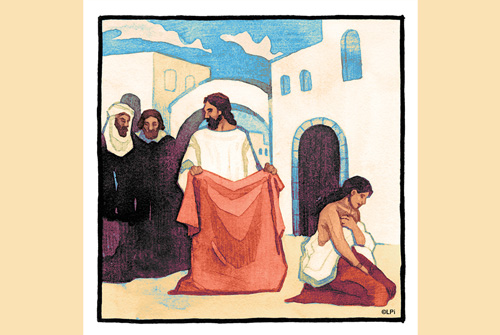
Our gospel passage is very familiar to us and one that clearly manifests God’s mercy; “The Woman Caught in Adultery.” According to Jewish law, such a woman should be stoned to death, and the ones to cast the first stones were to be the witnesses who caught her in the act. The Pharisees brought her to Jesus, not for confirmation of the law, but to trap him into forgiving her contrary to the law. Not saying a word, Jesus bent down and began writing in the dust with his finger. Of course, we have no confirmation of what he wrote but tradition has always believed he was writing the sins of the witnesses for all to see: “Let the one among you who is without sin be the first to throw a stone at her.” One by one, they went away, leaving her alone with Jesus. Suddenly, there were no witnesses, and by Jewish law, witnesses were necessary to condemn her; there were no witnesses and no condemnation. Neither does God condemn her. Through the mercy of God, she is forgiven her serious sin and given a second chance. In this woman, we should see that there is no sin greater than God’s love, even mortal sin, if it is repented and humbly confessed.
How often are we like the Pharisees? We often want to see others punished for sins and crimes against us or others. We have civil courts to determine guilt and punishment for criminal behavior and they are necessary to protect society from such behavior. Hopefully, our criminal justice system provides not only punishment but rehabilitation as well for such individuals and our prison ministries bring God into the lives of the incarcerated. If so, we bring glory to God, and nations will come to recognize God through our works.
Reference: ©LPi