A Reflection on the Readings for the Thirty-second Sunday in Ordinary Time, November 10, 2024
Reading: 1 1 KGS 17:10-16
Responsorial Psalm: PS 146:7, 8-9, 9-10
Reading: 2 HEB 9:24-28
Alleluia: MT 5:3
Gospel: MK 12:38-44
Our first reading this week is from the 1st Book of Kings which is part of what is known as Deuteronomistic History (DH). I’m sure I have discussed DH in the past so I’ll try not to repeat myself but, we understand the books of Joshua, Judges, Samuel (1&2) and Kings (1&2) as a history of the Israelite people from their entry into the Promised Land under the leadership of Joshua to the dissolution of the northern kingdom of Israel by the Assyrians (722 B.C.) and the destruction of the southern kingdom of Judah in the Babylonian Exile (587 B.C.). But it’s also important to note that in the Israelite tradition those books are called “The Former Prophets” because of the belief that the writing of history was a prophetic endeavor. In other words, copy what was good in your history and avoid what was bad. So, if we see those books as the Former Prophets, then they tell the story of the rise and fall of the nation of Israel and of the Israelite monarchy.
The Book of Deuteronomy serves as an introduction to that history by re-presenting the law by which that history is to be judged. The question in DH is: Does the history show obedience or disobedience to the law? The answer is that the history shows disobedience; and the punishment for that disobedience is the dissolution of the kingdom and the Babylonian Exile.
The stories we read in DH were passed down through many generations before being collected and compiled by the authors and editors as we have them today. The date for composition of DH is not known precisely but it is generally believed to have been begun shortly before the Babylonian invasion (late 7th century B.C.) and completed during the Exile.
Elijah (his name means: “Yahweh is my God’) was a prophet active in the northern Kingdom of Israel after the nation had separated into Israel and Judah. Elijah was prominent in the struggle to preserve the worship of Yahweh in Israel against the worship of Baal introduced by Jezebel, the wife of King Ahab of Israel. In our reading, Elijah is fleeing from the wrath of Jezebel and is sent by God to the widow of Zarephath whom God had designated to care of him. In the encounter between Elijah and the widow we see the “golden thread” that will bind our first reading to our gospel; and that is the virtue of charity. Not only the charity of the widow who feeds Elijah even though she doesn’t have enough for herself and her son, but the charity of God who assures her: “The jar of flour shall not go empty, nor the jug of oil run dry.”
Our Responsorial Psalm continues the theme of God’s charity toward us. God keeps faith forever, gives food to the hungry, gives light to the blind, etc.
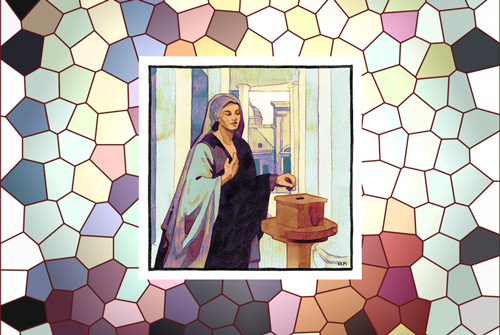
In our gospel passage, Jesus contrasts the actions of the wealthy with those of the poor widow. The wealthy contribute to the temple treasury but do so to be recognized by others. They wear long robes and seek seats of honor in the synagogues and say lengthy prayers in their attempt to impress others and in the hope of winning favor with God. Yet the widow, who could benefit from the charity of the wealthy but does not get it, contributes all she has and seeks no recognition from others for doing so.
Charity is a Christian virtue that is expected of us. But it is only a Christian virtue when it is rooted in the charity of Christ through Christian faith. It is through Christ that our faith merits us the grace of God, and it is that grace that makes our charitable acts virtuous. Even evil persons can do acts of charity, but an evil person cannot merit God’s grace because their charity is not rooted in the charity of Christ and in the Christian faith.
Our second reading from the Letter to the Hebrews reminds us that the grace we receive from God comes to us through Christ: “that he might now appear before God on our behalf.” Jesus’ sacrificial offering was to: “take away the sins of many.” When he appears again, it will not be to take away sin, “but to bring salvation to those who await him.” Therefore, it is evident that the grace of God reaches us through faith in Christ alone.
We cannot earn our way into heaven simply through acts of charity; but we can find our way into heaven through the grace of God. That grace comes through faith and the sacraments of the church, and that grace transforms our good deeds into virtue.
Reference: Illustration ©LPi