A Reflection on the Readings for the 24th Sunday in Ordinary Time, September 15, 2024
Reading 1: Is 50:5-9a
Responsorial Psalm: Ps 116:1-2, 3-4, 5-6, 8-9
Reading 2: Jas 2:14-18
Gospel: Mk 8:27-35
The Book of the Prophet Isaiah covers approximately 250 years, so it is not totally the work of the prophet himself. Isaiah’s work was carried on by his disciples, the disciples of the disciples, and finally, the editors who put their work into the form we have today, all under divine guidance. Consequently, the book is often divided into 1st, 2nd, and 3rd Isaiah to distinguish the time periods covered by the work.
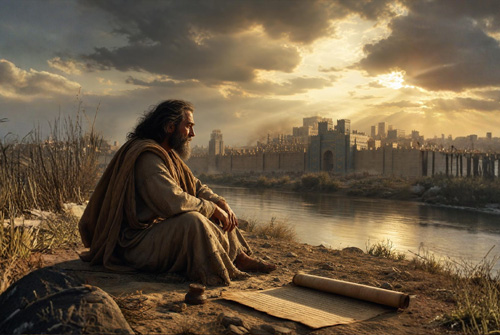
Our reading is from 2nd Isaiah, from the time of the Babylonian Exile, and reflects the feeling of abandonment the people would have felt during the exile and the destruction of Jerusalem and the temple. That abandonment would have made the people feel they had given: “my back to those who beat me, my cheeks to those who plucked my beard.”
This reading is also one of the four famous “Suffering Servant” messianic prophesies in Isaiah. If you care to review them, they are: 42:1-9; 49:1-7; 50:4-11 and 52:13 – 53:12. They are prophecies of the Messiah who will deliver and redeem Israel and of the great suffering the Messiah will endure. At the time of writing, it would be unclear as to the identity of this “Suffering Servant;” is it the nation of Israel itself; is it the prophet himself; will it be a descendent of David? Christianity, of course, attributes that identity to Christ and the fourth of those prophecies in chapter 53 is a vivid description of the suffering that Christ would endure some 500 years after the time of writing. In our reading it is the Servant himself that is speaking; if we read further to verse 11, we hear God’s rebuke of the people for not following the Servant.
The message in this reading for us and for those who originally heard it is belief in God’s word, spoken through the prophet, and trust in God to fulfill what he promised: “See, the Lord God is my help; who will prove me wrong?”
Our second reading from the Letter of James is also a very famous passage and contrasts faith and works, and therefore highlights the need for Christian charity. There are always those who claim to have great faith in God but do not back that faith up with care and concern for their neighbors. According to James, faith without works of Christian charity is dead. This reading may seem a contradiction of the teaching of St. Paul, especially in the Letter to the Romans chapter 4, wherein Paul affirms that justification comes through faith only. It is probably better not to look for a contradiction but to see Christian charity as the natural fulfillment of the Christian faith. True faith should impel us to reach out to those in need whenever we see that need.
In turning to our gospel passage from Mark, we see this messianic prophecy of Isaiah fulfilled, and the prediction of the Passion of Christ in this passage fulfills the prophecies of the “Suffering Servant.” When Jesus asked the disciples: “Who do the people say that I am?” We see that the people considered Jesus to be the reincarnation of John the Baptist or one of the other prophets, but they were not ready to accept him as the Messiah; and even today that is still the case for many Jews and Gentiles alike. But the disciples had made the connection between the prophecy and the reality: “You are the Messiah.” But apparently, the connection wasn’t total, as Peter attempted to alter God’s plan for which he was rebuked by Jesus. Peter was told that he was thinking as man thinks, not as God thinks. If it is God’s plan, we are to accept the plan as we cannot alter it. Peter, and all of us as Disciples of Christ, were commanded to think as God thinks. A true disciple will deny himself and accept the trials and tribulations of this life thereby losing his self-centered life for the sake of the gospel. The word “Gospel” means “good news;” and Jesus is that gospel.
The “Golden Thread” this week: Believe and Trust. We all face many little crucifixions in life as life is hard. But if we truly believe that faith we profess and live in hope and Christian charity, we will be led to a life of resurrection rather than crucifixion. Charity is the fulfillment of all our works. We must think as God thinks and follow his commands.
Reference: ©LPi