A Reflection on the Readings for the Twenty-third Sunday in Ordinary Time, September 8, 2024
Reading 1: Is 35:4
Responsorial Psalm: Ps 146:6-7, 8-9, 9-10
Reading 2: Jas 2:1-5
Gospel: Mk 7:31-37
Our first reading from chapter 35 of Isaiah comes from a critical time in Israel’s history when Isaiah was called to the prophetic office in the second half of the 8th century B.C.
At this time in Israel’s history, the northern kingdom of Israel had fallen to the Assyrians in 722 B.C., and now the southern kingdom of Judah, including Jerusalem, was under threat by the Assyrians as well. If we read further into chapters 36 and 37 of Isaiah, we will see that God intervened on behalf of Jerusalem. The Assyrian army suffered a plague that laid waste most of the soldiers. That which was left of the army returned home, and Assyria was never a threat again.
However, a greater threat was looming for Israel from the nation of Babylon, resulting in the Babylonian Exile beginning in 597 B.C., as a punishment from God for the infidelity of the people and their leaders. In our first reading from chapter 35, God comforts his people through the words of Isaiah, saying, “Be strong, fear not! Here is your God… He comes to save you.” In Isaiah’s words, the trials and tribulations of the exile will be nothing compared to the joy that will come with Israel’s deliverance. Then the “eyes of the blind will be opened” is not only a reference to physical blindness but to the blindness of the heart, which allowed the infidelity for which the people were punished. “The ears of the deaf will be cleared” is also a reference to hearing God’s word and acting on that word. Judah and Jerusalem would suffer the punishment of that exile, a punishment that served to purify the remnant of Israel that would eventually be delivered from the exile and return to their homeland. And that purified remnant would realize that the trials and tribulations of the exile were nothing compared to the joy that came with Israel’s deliverance. Our reading from chapter 35 is similar to the description of the return from exile as found in chapters 40 to 55.
As this was a critical time for Israel when Isaiah spoke, it is also a critical time for the church today. We should take comfort in those words of Isaiah when we consider the trials and tribulations the church has experienced from the sexual scandal of the past few years. We may be inclined to wonder who in the hierarchy of the church we can trust? Much of the hierarchy is complicit in the scandal, and we may feel they cannot be trusted to clean up this mess. We have no one to trust but God to clean the house. But we can take comfort in the words of Isaiah, “Be strong, fear not.” God will purify the church because we have Jesus’ words: “…upon this rock I will build my church, and the gates of the netherworld shall not prevail against it.” (Mt 16:18). The church will suffer much persecution because of the scandal (consider the persecution a crucifixion), but then there will be a resurrection when the purified remnant of the church will arise pure and holy, just as the purified remnant of Israel arose and was re-established. Then we will see with the eyes of the mind and hear with the ears of the heart. This is a critical time for us to remain strong in our faith; faith in God’s providence and in the words of Jesus.
Our second reading from the Letter of James reminds us that the church is called to solidarity. There will always be socio-economic and cultural differences in the members of the Christian community, but we are called to be one body, without discrimination. Always much easier said than done, but it is the standard we are called to. James also admonishes us to adhere to our faith in Jesus, as it is only those who are rich in faith, not in materialism, that will inherit the kingdom promised to those who love him.
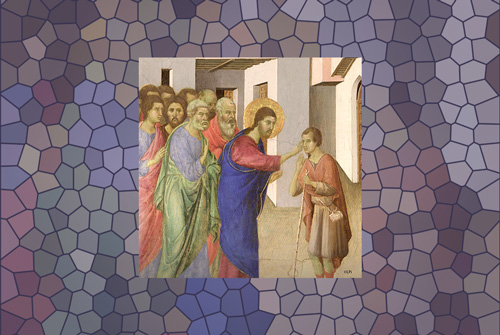
Our gospel passage is an account of one of Jesus’ miracles of healing, in this case the healing of a deaf mute in the district of the Decapolis. The Decapolis was a group of Ten Roman Cities east of the Jordan River, which means that Jesus was extending his ministry into Gentile territory where the people of the area acknowledged his power: “He does all things well. He makes the deaf hear and the mute speak.”
The healings we see in the gospel and in our first reading from Isaiah are physical healings of the deaf, the blind and the lame. But they are analogous to the healings of faith when the eyes of the mind and the ears of the heart are opened. However, it is significant that the man in our gospel was healed of his infirmity because he came in physical contact with Jesus, who touched the man’s tongue and put his fingers in the man’s ears. We, too, are healed of the infirmities of our faith when we come in contact with the Body of Christ in the sacraments of the church which Jesus left for that purpose. Our faith, which is so critical for us at this time, must be maintained by frequent contact with The Body of Christ in the sacraments. We must trust in God to heal and maintain our faith and to purify our church.
“Father, let your salvation come to us as you have promised, that we may keep your law always and, taught by the Word of truth, find strength in his salvation.”
Painting reference: ©LPi